🏛️ Urbs Salvia: The Little Rome in the Heart of Picenum
There is a place in the Marche region where time seems to have stood still since the era of Emperor Tiberius. This is Urbs Salvia, modern-day Urbisaglia. If you are looking for the essence of Roman urban planning, far from the chaos of the major tourist circuits, this is the place to be. As a guide, I always say that one does not simply visit Urbs Salvia: one “crosses” it like a journey through time.
The History: The Rise of a Powerful Municipium
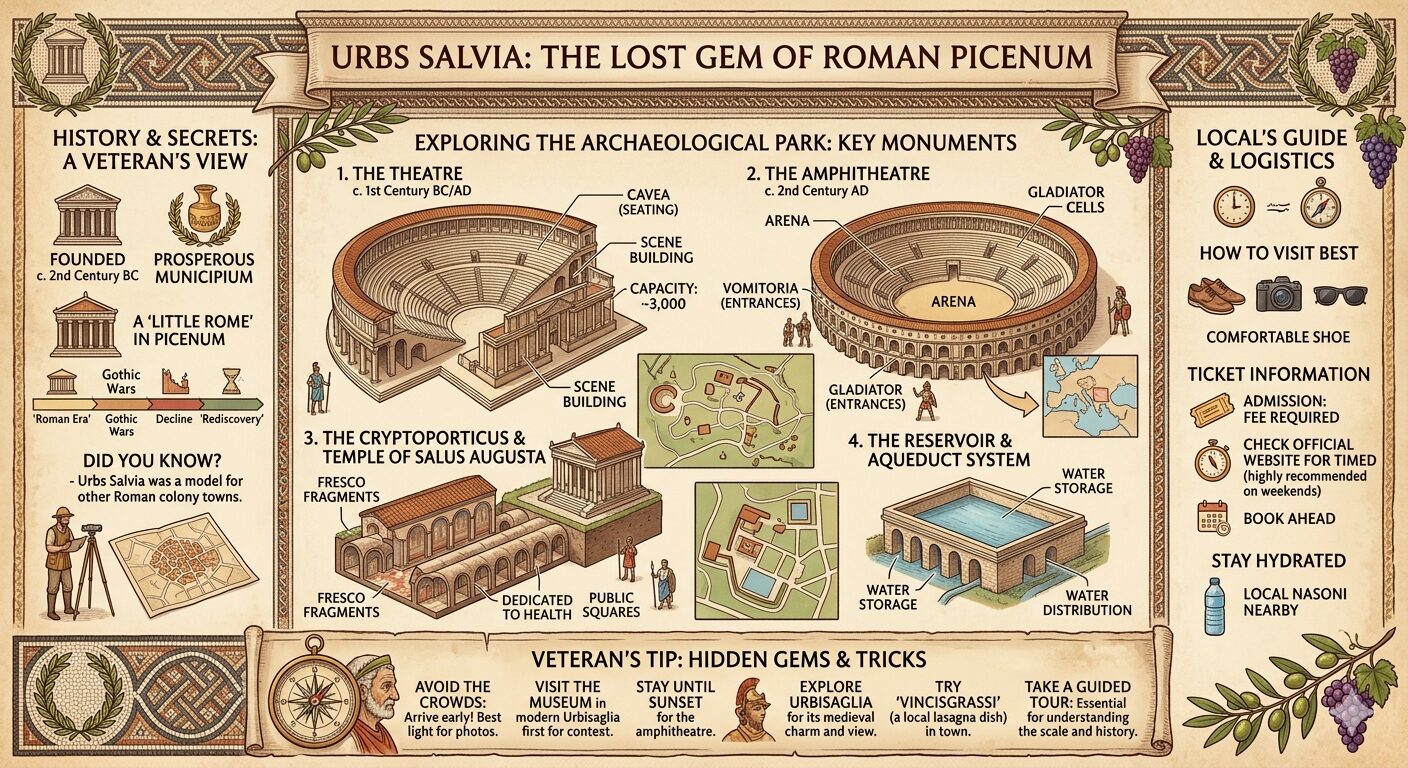
Founded as a colony in the 2nd century BC, Urbs Salvia became a monumental hub under the Julio-Claudian dynasty. It was not just a city, but a manifesto of Roman power in the territory of the Piceni people. Its importance was such that its citizens reached the highest levels of imperial administration in Rome. Its decline began with the barbarian invasions (Alaric in 409 AD), but what remained underground is a treasure of inestimable value.
The Monuments: An Artistic Journey
The archaeological park spans approximately 40 hectares. Here is what you absolutely cannot miss:
The Theatre: One of the largest in Italy, capable of seating nearly 3,000 people. What makes it unique is the preservation of original pictorial decorations in some internal sectors.
The Temple-Cryptoporticus Complex of Salus Augusta: This is the sacred heart of the site. The cryptoporticus is a quadrilateral underground corridor that served as the foundation for the temple above. Here you will find extraordinary frescoes in the “Pompeian Third Style,” featuring hunting scenes and theatrical masks that have retained incredibly vivid colors.
The Amphitheatre: Located outside the walls, it is imposing. This is where gladiatorial games took place, drawing crowds from all over Picenum.
The Aqueduct Reservoir: A masterclass in Roman hydraulic engineering, featuring two large parallel chambers for water settling.
Logistics and Advice
Booking: It is essential to contact the Urbisaglia tourist office. Many structures are closed and are only opened with a park guide (highly recommended to access the cryptoporticus).
Clothing: Comfortable shoes. You will be walking a lot through grass and dirt paths.
Weather: In summer, it gets very hot and shade is scarce among the monuments. Better to visit early in the morning or late in the afternoon.
Tourist Guide Pro Tips
Visitor Information (April 2026)
Hours: During April, the park is open on Saturdays, Sundays, and public holidays from 10:30 AM to 12:30 PM and 3:00 PM to 6:00 PM. Weekday visits are usually by reservation only.
Tickets: Tickets can be purchased at the Amphitheater entrance. Entry is free on the first Sunday of the month.
State Archaeological Museum: Located in the upper medieval town, it houses smaller artifacts, sculptures, and inscriptions found on-site.
Contact: For bookings or info, call +39 0733 506566 or email turismo@comune.urbisaglia.mc.it.
Getting There
By Car: Take the SS77 highway (Civitanova-Foligno) to the Macerata Ovest/Abbadia di Fiastra exit and follow signs for Urbisaglia.
Parking: Free parking is available right at the entrance of the Amphitheater (SP 78).
Many tourists make the mistake of only visiting the archaeological park in the valley. My veteran advice is this:
Start from the top: Go first to the medieval village of Urbisaglia. Visit the State Archaeological Museum to see the portable artifacts (statues and inscriptions) that provide context for what you will see below.
The Fortress (La Rocca): Climb the medieval Fortress. From the tower, you will have a bird’s-eye view that will allow you to perfectly understand the layout of the Roman city below, clearly distinguishing the area of the theatre and the amphitheatre.
The Culinary Break: You cannot leave Urbisaglia without tasting Vincisgrassi, the Marche version (and much richer) of lasagna. Ask at a local trattoria in the village: it is the best way to honor the tradition of banquets which, in truth, have never ended since Roman times.