When people think of the Italian Riviera, they envision the colorful houses of Portofino or the cliffs of Cinque Terre. But as a guide who has walked these lands for decades, I want to take you to a place where the stones speak a more ancient language: Luni.
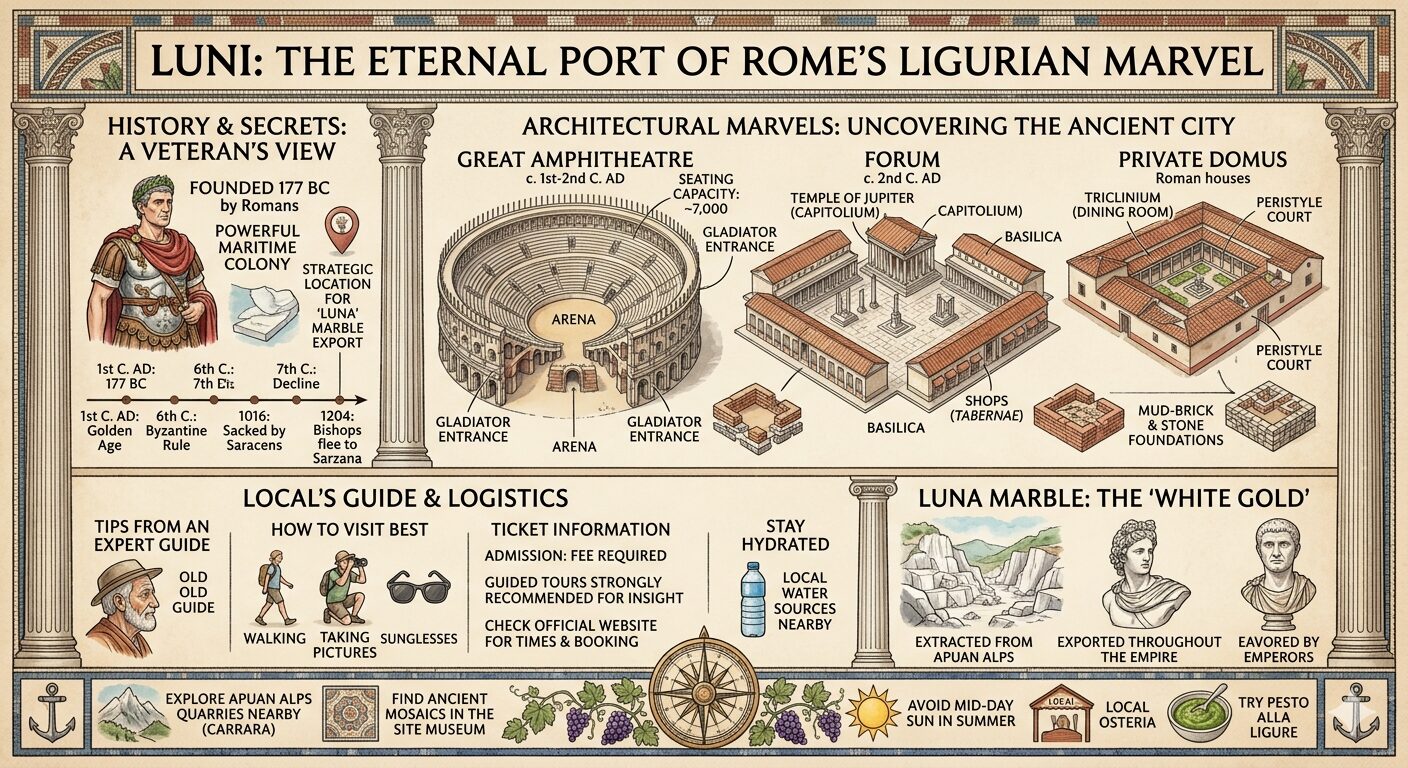
Located on the border between Liguria and Tuscany, Luni (the ancient Luna) was once one of the most prosperous ports of the Roman Empire. Today, it is a serene archaeological park where the ghosts of gladiators and merchants linger among white marble ruins.
A Brief Glimpse into the Past
Founded in 177 BC, Luni was built as a strategic military outpost to subdue the fierce Ligurian tribes. However, its true destiny was carved in stone. The city became the primary port for exporting Carrara marble (known then as Marmo Lunense), the very material used to build the Pantheon and Trajan’s Column in Rome. Pliny the Elder once praised the “whiteness” of the city, which from the sea looked like a shimmering crescent moon.
What to See: The “Must-Visits”
The Great Amphitheatre: Located outside the city walls, this is the crown jewel of the site. It once held 7,000 spectators. Walking through the vaulted entrances (vomitoria), you can almost hear the roar of the crowd.
The Forum & Grand Temples: This was the beating heart of public life. Look for the remains of the Great Temple dedicated to Selene-Luna.
Domus of the Mosaics: We guides love this spot. The intricate floor mosaics, depicting maritime scenes and mythology, are remarkably preserved and offer a window into the luxury of Roman provincial life.
The Veteran’s Insight: The “Why” Behind the Ruin
Why did such a magnificent city disappear? It wasn’t just war. The coastline moved. Over centuries, the Magra river deposited silt, pushing the sea further away. By the Middle Ages, the glorious port was inland, surrounded by marshes. Nature reclaimed what man had built, preserving it for us to find today.
Logistics for the Modern Traveler
Getting There: It is best reached by car. It’s a 20-minute drive from La Spezia or Sarzana.
Timing: Allow at least 2 to 3 hours. The site is vast and requires walking on uneven ground.
Booking: While you can often buy tickets at the gate, checking the National Directorate of Museums for seasonal opening hours is vital, as they vary greatly between summer and winter.
Tourist Guide Pro Tips
Visitor Information (April 2026)
Hours: Open Tuesday to Saturday (8:30 AM – 7:30 PM) and Sunday (8:30 AM – 1:30 PM).
Closed: Usually closed on Mondays, except for special holiday openings.
Tickets:
Full Price: €5.00
Reduced (ages 18-25): €2.00
Free: Under 18.
Location: Via Appia 9, Luni (SP). It is easily accessible via the A12 highway (Sarzana or Carrara exits) or by regional train to the Luni station.
Most tourists visit Luni and then rush back to the coast. Don’t. Instead, after your visit, drive 10 minutes up to the medieval village of Nicola. From its balcony-like piazzas, you can look down at the entire archaeological plan of Luni from above. You will see the exact “footprint” of the Roman colony amidst the modern fields—a perspective no guidebook will tell you about.
And for lunch? Avoid the highway stops. Look for an Osteria in nearby Sarzana and ask for Testaroli with Pesto. It is the oldest form of pasta, dating back to Roman times—the perfect culinary bridge to your morning in antiquity.