Necropoli del Crocifisso
- Region: umbria
- Location: Strada della Stazione, Orvieto (TR)
- Built: 6th and 5th centuries BC
Listen to the Guide
A Journey through the Necropolis of the Crocifisso del Tufo
Strolling through the avenues of the Necropolis of the Crocifisso del Tufo is not like visiting a typical archaeological site. It is an experience that requires a slow pace and a gaze capable of reading between the lines of the stones. While most tourists crowd under the facade of the Duomo, here, at the foot of the Orvieto cliff, one breathes the true essence of the Etruscans.
🏺 A Masterpiece of Urban Planning: The Mirror City
Unlike other Etruscan necropolises (such as those in Cerveteri or Tarquinia, famous for their mounds or paintings), the one in Orvieto stands out for its geometric rigor.
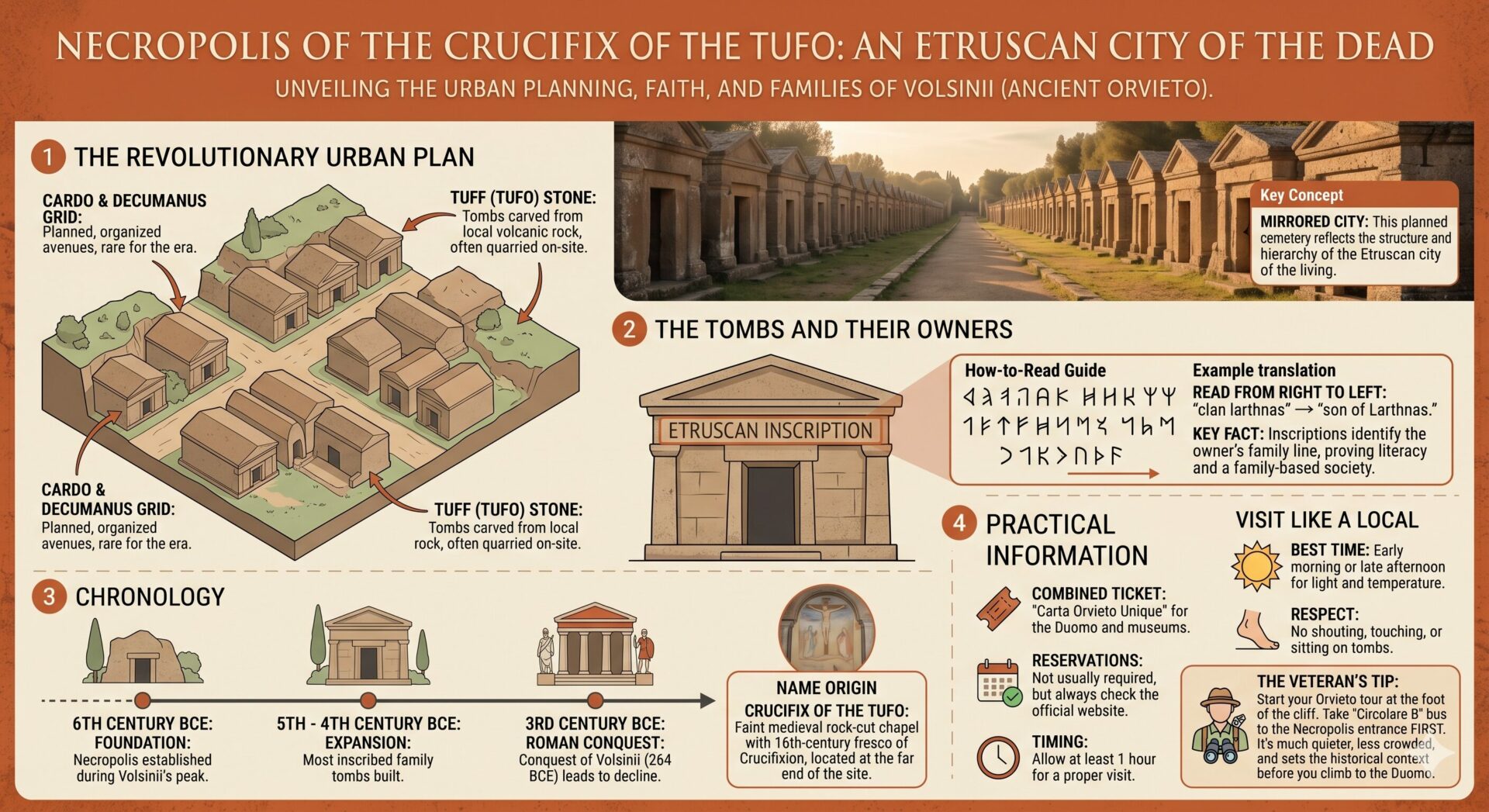
We are in the 6th century BCE, and the inhabitants of ancient Volsinii decided to build their “City of the Dead” following an orthogonal plan. It is an almost unique case: straight streets that cross at right angles, creating precise blocks. Why did they do this? Because the necropolis was meant to be the mirror of the city of the living that rose above them on the cliff. It is a concept of democracy and social order ahead of its time.
🖋️ The Archaeology of Names: Who Were the Etruscans?
Look closely at the lintels above the tomb entrances. You will notice engravings. These are not decorations, but “speaking” inscriptions. In Etruscan, writing runs from right to left. You will read formulas like “Mi Larthnas” (I am [the tomb] of Larth).
The Veteran’s Tip: These writings are proof of a literate society and an emerging “middle class.” Not just kings or princes, but entire families who wanted to leave their names for posterity. It is the first example of a “surname” in Western history.
✝️ The Mystery of the Name: From Paganism to the Middle Ages
Many ask me: “Why does an Etruscan necropolis have the name of a Crucifix?”. The answer is hidden in a small rock-cut chapel carved into the tuff, located along the perimeter of the site. Inside is an ancient crucifix (a 16th-century fresco) that gave its name to the entire area. It is a wonderful example of how history layers different faiths: where pagan ancestors were once honored, a Christian place of worship was born centuries later.
Tourist Guide Pro Tips
🚶 Logistics and Practical Advice
- Booking: It is not mandatory for individuals but recommended for groups. However, always check the Direzione Regionale Musei Umbria website for any extraordinary closures (Monday is often a day of rest).
- Weather: The site is entirely outdoors. In summer, the tuff cliff reflects heat incredibly; visit the site at 9:00 AM or an hour before closing to enjoy the golden light that sets the tuff ablaze with an almost magical orange hue.
- Opening Hours (Antiquarium): Generally Thursday to Sunday, 9:00 AM – 6:00 PM (summer hours may extend to 7:00 PM). It is typically closed Monday through Wednesday.
- Tickets: Approximately €3.00. It is often included in combined tickets with other Orvieto landmarks.
- Top Tip: You can reach the necropolis by walking the Anello della Rupe (Cliff Ring Path), a panoramic trail that encircles the base of the city.
💡 The Trick of the Trade
“If you want to avoid the crowds and enjoy the most beautiful view of Orvieto, don’t descend to the necropolis starting from the historic center. Do the opposite: take the circular bus (‘Circolare B’) or a taxi from the station (Orvieto Scalo) to the entrance of the Necropolis at the base of the cliff. After your visit, walk back up towards the city along the Ring Path of the Cliff (Percorso ad Anello della Rupe – PAO). It is an uphill walk, yes, but it allows you to see how the city and the necropolis are literally carved from the same stone. You will reach the top tired, but with an understanding of the place that no tour bus could ever give you.”
🍷 Authentic Break: Where do the locals eat?
Forget the places with “tourist menus” near the Duomo. After your visit, look for a small trattoria in the less-trodden streets of the medieval quarter (San Giovenale area).
- What to order: Umbrichelli (typical local hand-rolled pasta made with water and flour) with truffles or all’arrabbiata.
- The wine: A glass of Orvieto Classico Superiore. It is a wine that tastes of minerality and tuff. Ask for one from a small local producer: it is the liquid soul of this land.
Respect the silence of this place. You are not in a museum; you are in a neighborhood where time stopped 2500 years ago.