Abbazia di Casamari: The Cistercian Soul of Latium
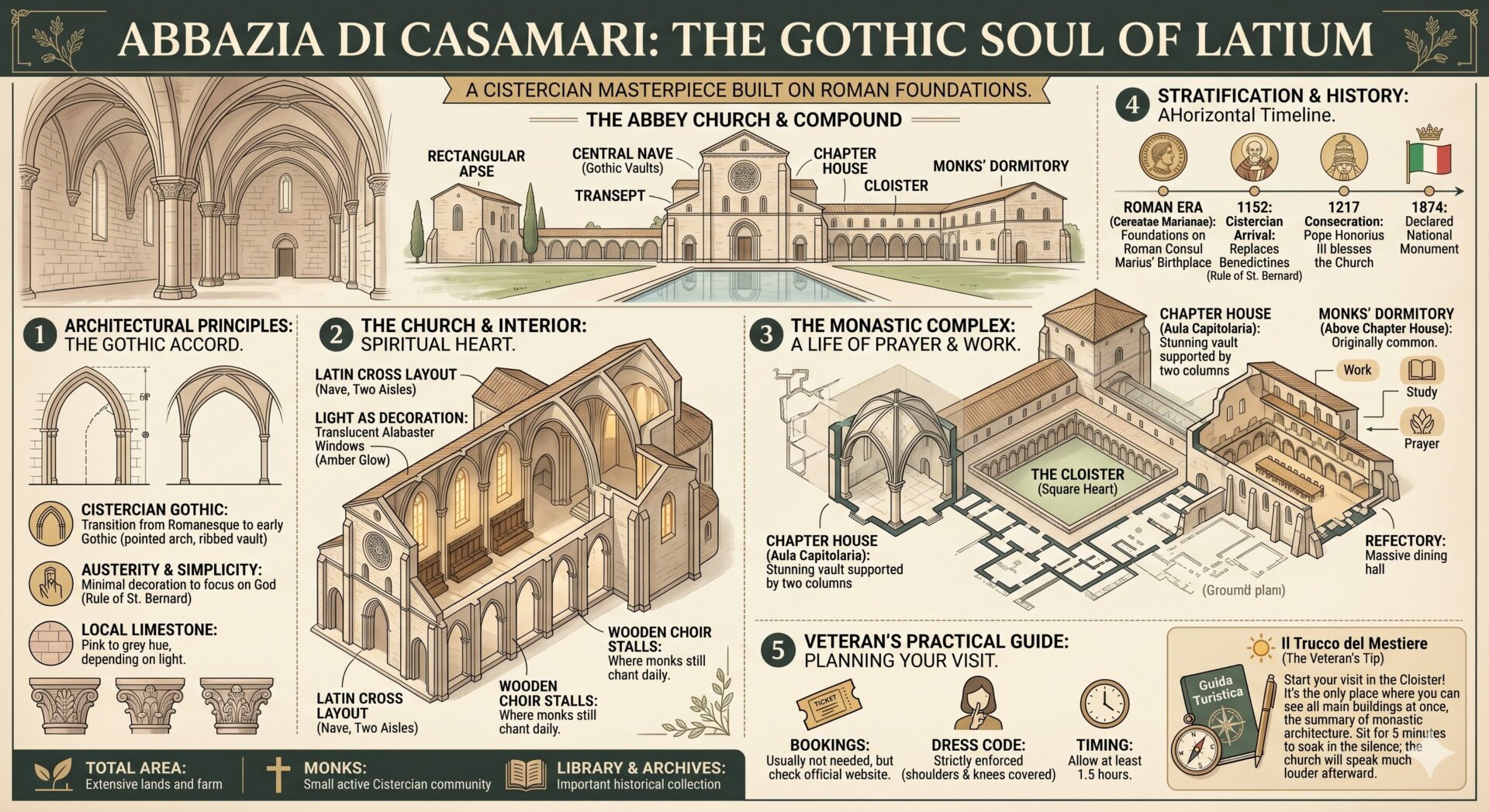
Located in the municipality of Veroli, about halfway between Rome and Naples, Casamari is one of the finest examples of Cistercian Gothic architecture in Italy. It stands as a “fossil” of 13th-century monastic life, still inhabited today by a community of Cistercian monks who follow the rule of Ora et Labora (Pray and Work).
🏛️ 1. History: Built on Roman Foundations
The name “Casamari” literally means “House of Marius.” The abbey was built on the ruins of Cereatae Marianae, the birthplace of the famous Roman consul and general Gaius Marius.
The Origins: Originally a Benedictine monastery in the 11th century, it fell into decline until the Cistercian reform took over in the mid-1120s. The Cistercians, led by the influence of St. Bernard of Clairvaux, sought a return to austerity and manual labor.
The Construction: The current structure was built between 1203 and 1217. It was consecrated by Pope Honorius III.
The Survival: Unlike many other abbeys, Casamari survived the Napoleonic suppressions and the World Wars relatively intact, allowing us to see it today exactly as it appeared to a medieval monk.
🎨 2. Art and Architecture: The Power of Austerity
Cistercian architecture is defined by “The Law of Silence.” You won’t find frescoes here; the monks believed that colorful paintings distracted the mind from God.
The Façade: Look for the massive porch with five arches and the stunning Rose Window. The geometry is perfect—a symbol of divine order.
The Interior: The church has a Latin cross plan with three naves. Notice the windows: they are not glass, but thin sheets of translucent alabaster. When the sun hits them, the church is filled with a warm, amber glow that is simply mystical.
The Chapter House: This is an architectural marvel. It is a square room where the monks met daily to discuss the “Chapter” of the Rule. The entire vaulted ceiling is supported by only two incredibly elegant central columns.
The Cloister: The square heart of the abbey. The twin columns and the lush garden represent the Garden of Eden.
⛪ 3. The Religious Experience
Casamari is an active monastery. You will likely see monks in their white habits with black scapulars.
Gregorian Chant: If you time your visit correctly (usually during Sunday Mass or Vespers), you can hear the monks singing Gregorian chants. The acoustics of the bare stone walls make the sound feel like it is floating.
The Rule of St. Benedict: The monks still live self-sufficiently, producing their own honey, oils, and liqueurs.
Tourist Guide Pro Tips
🚗 4. Logistics: Driving and Directions
Casamari is best reached by car. It is located just off the “Superstrada” (freeway).
From Rome: Take the A1 Motorway (Autostrada del Sole) south towards Naples. Exit at Frosinone. Follow signs for the Sora/Avezzano (Superstrada SR214). Take the exit marked “Casamari”. The abbey is clearly visible from the road.
Parking: There is a large, free parking lot right in front of the abbey entrance. It rarely gets full unless there is a major religious holiday.
Travel Time: From central Rome, allow about 1 hour and 15 minutes.
🚶 5. Useful Information for Your Visit
Dress Code: This is a sacred site. Shoulders and knees must be covered. If you are wearing shorts or a tank top, you may be turned away.
Opening Hours: Generally open 9:00 AM – 12:00 PM and 3:00 PM – 6:00 PM. Always check the official website or call ahead, as hours can shift based on the liturgical season.
Entry Fee: Entry is free, though donations are appreciated.
Silence: Maintain a low voice throughout the complex.
💡 The Veteran’s Tip
“Most people visit the church and the cloister and then leave. Do not make this mistake. Look for the Antica Farmacia (Old Pharmacy) and the Liquoreria. The monks have been master herbalists for centuries. I highly recommend buying a bottle of their ‘Gocce Imperiali’ (Imperial Drops) or their Eucalittino. They make for a much better souvenir than a plastic keychain, and the proceeds help support the maintenance of the abbey. Also, if you visit in the late afternoon on a sunny day, the way the light filters through the alabaster windows in the nave is a sight you will never forget.”
Nearby Suggestions:
If you have time, drive 15 minutes further to the town of Isola del Liri, where you can see a spectacular waterfall right in the middle of the historic center—it’s a perfect spot for a post-abbey lunch!