Located in the province of Bergamo, Crespi d’Adda is an extraordinary “company town” and a UNESCO World Heritage site. Make yourselves comfortable, because today I am taking you to a place that seems to have frozen in 1920. It is not a medieval village, but something equally fascinating: an industrial utopia. Crespi d’Adda is not just a workers’ district; it is the dream of a dynasty, the Crespi family, who wanted to create the “perfect town” where work, family, and social life lived in total harmony.
The Vision: An Enlightened Paternalism
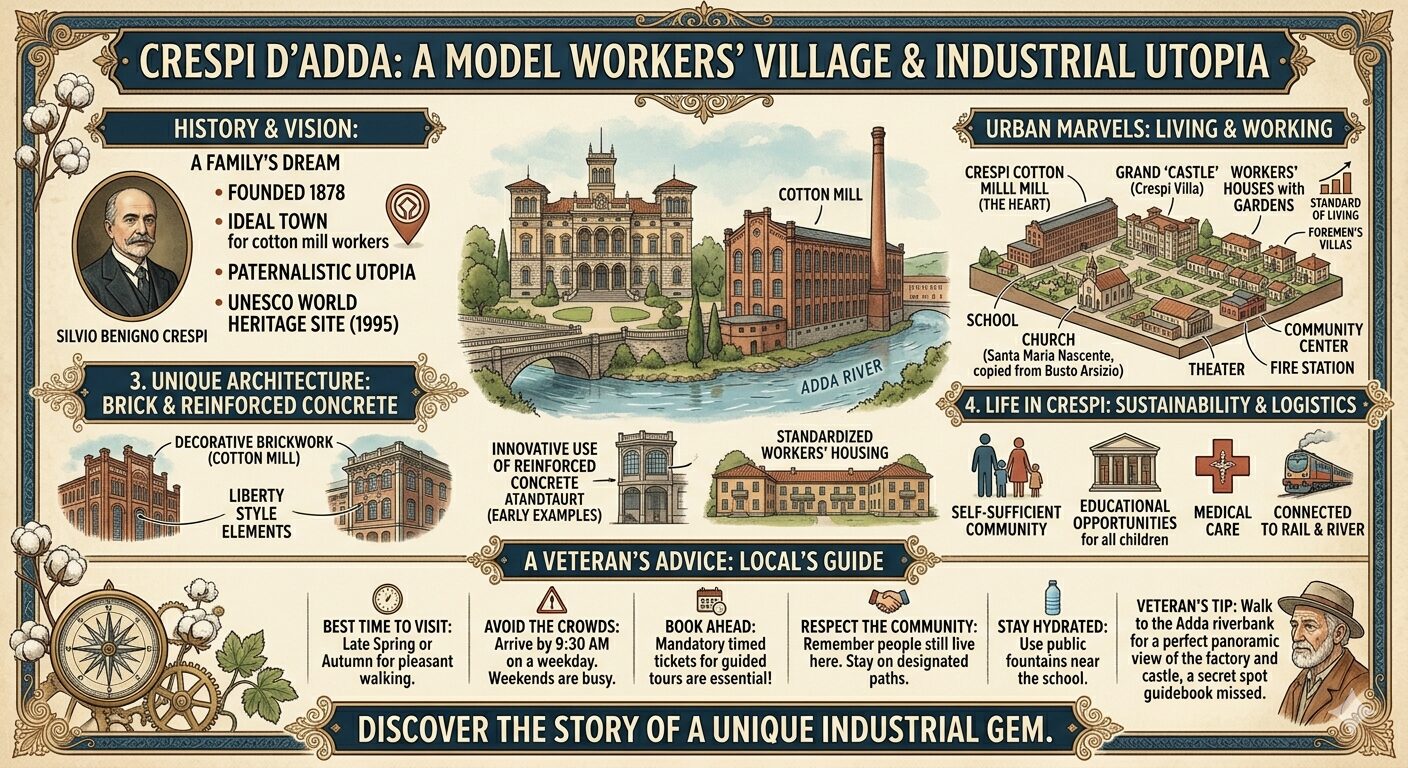
Founded in 1878 by Cristoforo Benigno Crespi, the town is a prime example of industrial paternalism. The idea was simple yet revolutionary: provide workers with everything they needed (home, garden, school, doctor, church) to ensure a happy workforce and, consequently, a more productive one. Walking through its streets, you will notice the geometric order: the workers’ houses, each with its own garden, arranged in parallel rows south of the factory.
Art and Architecture: Between Brickwork and Symbolism
The Factory (The Temple of Labor): Notice the monumental entrance. It doesn’t look like a mill, but rather a secular cathedral. The terracotta decorations and large arched windows are typical of the Lombard Liberty (Art Nouveau) style.
The Villa Crespi (The Castle): The owners’ residence, built in a neo-medieval style complete with a tower. From the top of the hill, the Crespi family could overlook both the factory and the village: a visual symbol of protection and authority.
The Church: It is an exact replica of the church of Santa Maria in Busto Arsizio, the Crespi family’s hometown. Bringing their own church here was a way to make the workers feel “at home.”
The Monumental Cemetery: At the end of the main avenue, it is dominated by the Crespi family mausoleum, a massive pyramid that seems to embrace the small, orderly rows of workers’ headstones: united in work, united in eternal rest.
Details that Make the Difference
If you look closely at the wooden fences of the villas, you will notice they are all different yet coordinated. Nothing was left to chance. Crespi d’Adda was also the first town in Italy to have electric public lighting and a completely free school for employees’ children, with books and materials provided by the factory.
Information for the Visit
Access: The village is still inhabited. Please respect the privacy of the residents. On weekends, car access is limited (ZTL zone), so be prepared to walk.
Booking: To enter the factory or for in-depth guided tours, booking is mandatory and must be done through the Crespi d’Adda Association.
Best Time to Visit: Spring, when the villa gardens are in bloom and the walk along the Adda river is refreshing.
Tourist Guide Pro Tips
Visitor Information (April 2026)
Since the village is still an active residential town, you can walk through its streets for free at any time. However, to enter specific buildings like the factory or the power plant, you must book a tour.
Guided Tours: Run by the Associazione Crespi d’Adda. Tours typically cost around €9.00 and last 90 minutes.
The Factory Tour: Specialized tours allowing access inside the historic cotton mill are available on select weekends.
Getting There:
By Car: Take the A4 Highway (Milan-Venice), exit at Capriate, and follow signs for Crespi d’Adda.
Public Transit: Take the Metro M2 (Green) to Gessate, then the Z301 bus to Capriate. It’s a 20-minute walk from the bus stop to the village.
Many visitors stop at the main street. I advise you to do two things that few others do:
The Adda Riverside Walk: Take the path that runs along the river behind the factory. From there, you will have the best view of the industrial architecture and understand the vital importance of water as an energy source.
The Detail of the Chimneys: Look at the factory’s old chimneys. They have been restored but still retain the charm of an era when smoke was not seen as pollution, but as a sign of prosperity and progress.
And for a bite to eat? Look for the small local bars within the village for a quick sandwich, but if you want something authentic, head a few miles towards Trezzano sull’Adda to taste the traditional Bergamo and Milanese dishes that meet right here on this water border.