Pienza
- Region: toscana
- Location: Pienza (Siena)
- Built: 1459-1462
Listen to the Guide
Pienza: The Stone Dream of Pius II – A Humanist Masterpiece
Welcome to Pienza. To look across this horizon is to witness the birth of modern urban planning. We are in the heart of the Val d’Orcia, a landscape recognized by UNESCO not just for its beauty, but as an exceptional example of the “Res publica” where the landscape was consciously redesigned during the Renaissance to reflect the ideals of good governance and aesthetic harmony.
🌍 1. Geography and Geomorphology: The Fragile Terrace
Pienza sits atop a calcarenite (sandstone) ridge approximately 500 meters above sea level. This position offers a strategic 360-degree view, stretching from the Mount Amiata (an ancient extinct volcano) to the fortress of Radicofani.
- The Soil: The very stone that gives Pienza its golden hue—sandstone—is also its greatest challenge. The ridge is prone to slow but persistent subsidence, particularly affecting the heavy structures on the southern edge.
- The Urban Layout: Unlike the winding, defensive “snake-like” streets of nearby medieval towns like Montalcino, Pienza’s layout was mathematically conceived to be open and luminous, favoring perspective over fortification.
📜 2. Historical Evolution: The Transfiguration of Corsignano
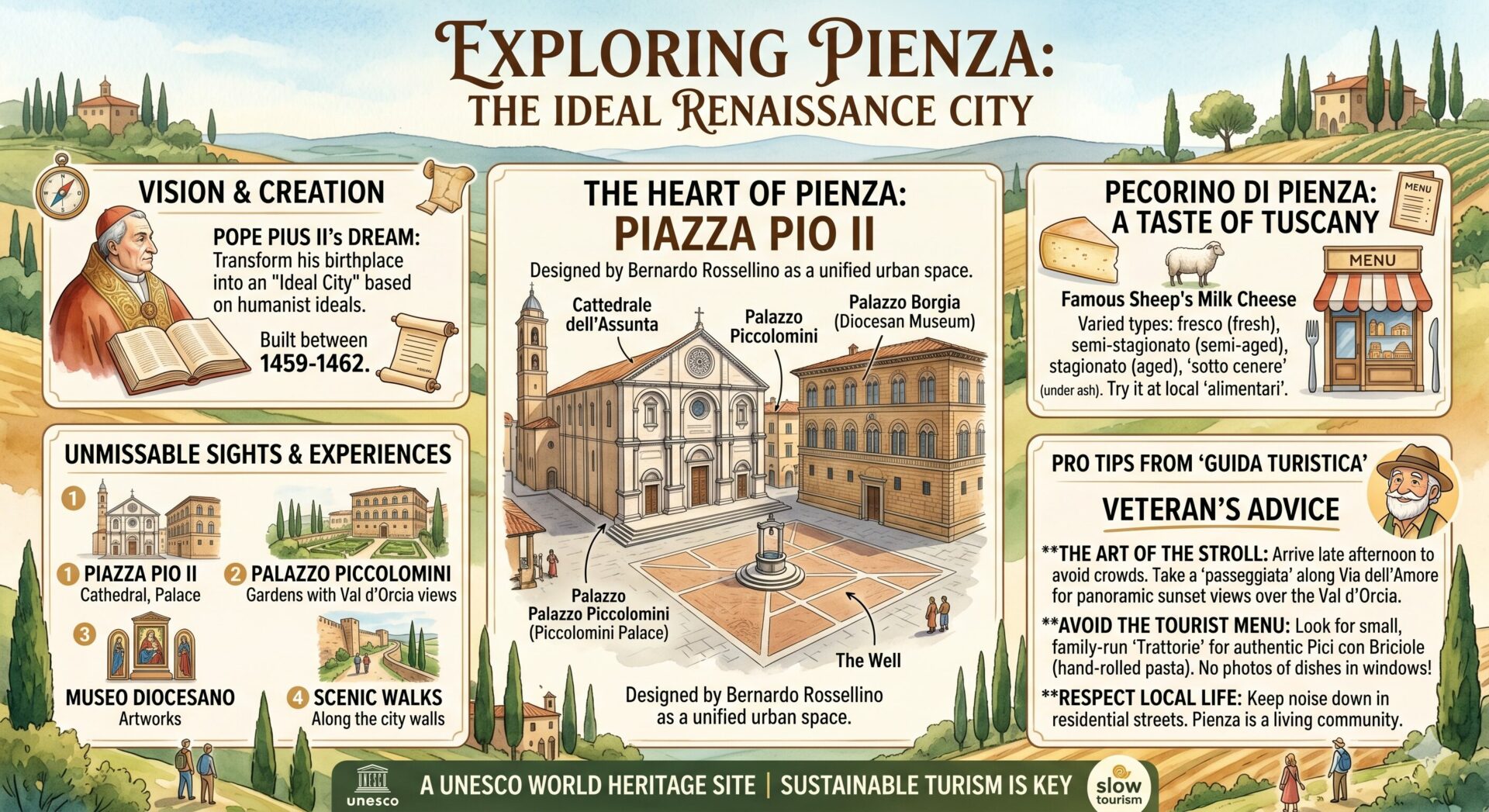
Until 1459, this was Corsignano, a humble fortified village. Everything changed when its most famous son, Enea Silvio Piccolomini, returned here as Pope Pius II.
- The Humanist Vision: Pius II was one of the greatest intellectuals of his time. He wanted to turn his birthplace into a “living classroom” of Humanism.
- The Architect: He commissioned Bernardo Rossellino, who worked under the theoretical guidance of Leon Battista Alberti. In just three years (1459–1462), they completed the central monumental complex. It was the first time in history that a city was built based on a unified master plan, earning it the title of “The Ideal City.”
🏛️ 3. Architecture and Theory: The Stage of Humanism
The center of Pienza is Piazza Pio II, a masterpiece of perspective and spatial hierarchy.
- The Trapezoidal Square: Rossellino did not build a perfect rectangle. By tapering the square towards the Cathedral, he utilized reverse perspective. This makes the square feel more intimate and the Cathedral facade appear significantly more monumental than it actually is.
- The Cathedral (Duomo): The facade is a classic Renaissance triumph of travertine. However, the interior is a surprising Hallenkirche (Hall Church). Influenced by his travels in Northern Europe, Pius II insisted on high, equal-height aisles and massive windows to create a “House of Glass,” symbolizing the light of reason and faith.
- Palazzo Piccolomini: Modeled after the Palazzo Rucellai in Florence, it features the first true hanging garden of the Renaissance. The three-tiered loggia on the rear is revolutionary; it was designed purely for the “contemplation of nature,” marking a shift from medieval isolation to the Renaissance embrace of the landscape.
🧀 4. Enogastronomy: The Terroir of the Val d’Orcia
Pienza is synonymous with Pecorino, but for the professional palate, it is a matter of terroir.
- The Secret of the Crete: The clay-rich soils (Crete Senesi) surrounding Pienza produce specific wild herbs like savory, thyme, and broom. When the Sarda sheep graze here, these aromatics pass directly into the milk.
- Technical Varieties: * Fresco: Aged less than 30 days, mild and milky.
- Stagionato: Aged in oak barrels or wrapped in walnut leaves, developing a spicy, nutty complexity.
- Pici and Wine: Always recommend the Pici (thick, hand-rolled pasta) with Aglione (a local giant garlic that is surprisingly sweet and digestible). Pair this with Orcia DOC, the local wine that bridges the gap between the structure of a Brunello and the elegance of a Vino Nobile.
🏺 5. Curiosities and Academic Details
- The Sliding Choir: The Cathedral’s apse is literally “drifting” down the hill. Since the 16th century, architects have struggled with massive cracks caused by the weight of the church on the soft sandstone. You can still see the monitoring sensors on the external walls today.
- The Papal Bull of Preservation: Pius II was so protective of his creation that he issued a Papal Bull (the Cum almam nostram urbem) forbidding anyone from altering the appearance of the buildings. This is arguably the world’s first urban heritage preservation law.
Tourist Guide Pro Tips
As a guide with 40 years of experience, I offer you these “trade secrets” for a superior visit:
- The Geometry of the Pavement: Tell your students or guests to stand on the brick grid in the center of the square. The grid is not decorative; it is the “geometric skeleton” that Rossellino used to align every window and door in the square. It is the visual proof of Renaissance order.
- The “Luce d’Oro” (Golden Hour): The sandstone used in Pienza is rich in iron. At precisely 18:30 in the summer, the oxidation causes the stone to glow with a deep orange hue. This is the moment to photograph the Via del Casello walls.
- The Real Pecorino Search: Avoid the shops that display large plastic cheese rounds outside. A true “local” shop is identified by its smell—pungent and earthy—and the presence of “Latte Crudo” (raw milk) cheeses. Raw milk preservation keeps the micro-flora of the Val d’Orcia alive in the cheese.
- Logistics: For professional groups, remember that Palazzo Piccolomini requires timed entry. The garden is small and can only accommodate about 25 people at a time. Book the “Gardens and Secret Rooms” tour for a much deeper historical immersion.
-
- From the North (Florence/Milan): Take the A1 Motorway (Autostrada del Sole) south towards Rome. Exit at Valdichiana/Bettolle. Follow signs for Torrita di Siena and then Pienza.
- From the South (Rome): Take the A1 Motorway north towards Florence. Exit at Chiusi/Chianciano Terme. Follow the SS146 road through Chianciano and Montepulciano until you reach Pienza.
- Parking: The town center is a ZTL (Restricted Traffic Zone). There are several paid and free parking lots located just outside the city walls (e.g., along Via Cassia or near the Coop supermarket).
-
- Step 1 (Train): Take a train to Chiusi-Chianciano Terme (on the main line between Florence and Rome) or Buonconvento (on the line from Siena).
- Step 2 (Bus): From Chiusi or Buonconvento, take a bus operated by Autolinee Toscane.
-
- Line 112 connects Siena to Pienza and Montepulciano.
- Tip: Always check the schedule in advance, as bus services are significantly reduced or non-existent on Sundays and holidays.
-
- Florence (FLR): Approx. 1.5 – 2 hours by car.
- Perugia (PEG): Approx. 1 hour 15 minutes by car.
- Rome (FCO/CIA): Approx. 2.5 hours by car.
May your journey through Pienza be not just a visit, but an encounter with the perfect harmony of the human spirit!