Location: via del trainello 28, 02021 Sant'Anatolia (RI)
Listen to the Guide
Duration: 43.28 - Narrated in English
Becoming a Professional Guide in Italy
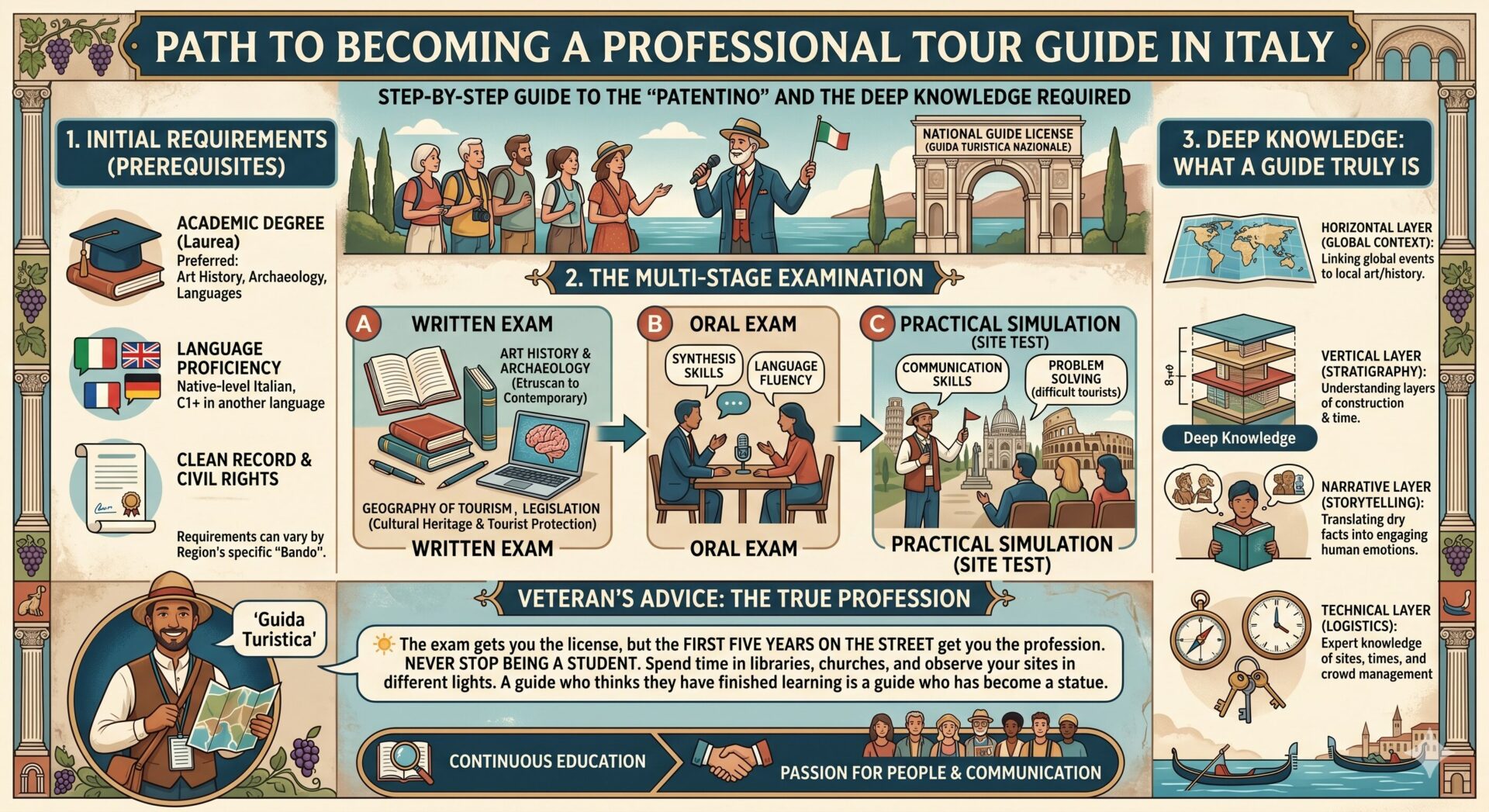
In Italy, the profession of Guida Turistica is regulated by law. It is not enough to love history; you must prove to the State that you are a qualified custodian of the national heritage.
1. The Legal Requirements
To sit for the national exam, you must generally meet these criteria:
Academic Degree: A three-year bachelor’s degree (Laurea) is mandatory. While degrees in Art History, Archaeology, or Languages are preferred, the requirement is often general, depending on the specific regional call (Bando).
Language Proficiency: You must demonstrate a C1 level (Common European Framework) in at least one foreign language and a native-level command of Italian.
Clean Record: Full civil and political rights and a clean criminal record.
2. The Examination Process
Exams are organized periodically by Regional authorities but grant a license valid throughout Italy. The exam usually consists of three phases:
Phase A: The Written Exam
A grueling series of multiple-choice and open-ended questions covering:
Art History & Archaeology: From the Etruscans to Contemporary Art.
Geography: Not just “where things are,” but the “Geography of Tourism”—infrastructure, protected parks, and climate.
Legislation: Knowledge of the laws governing cultural heritage (Codice dei Beni Culturali) and tourist protection.
Phase B: The Oral Exam
A face-to-face interview with a commission of university professors and art historians. They will test your ability to synthesize complex topics and your fluency in your chosen foreign languages.
Phase C: The Practical Simulation
The “Site Test.” You are taken to a monument or museum and asked to perform a 20-minute guided tour for the commission. They often play the role of “difficult tourists” to test your problem-solving and communication skills.
3. The “Deep Knowledge”: What a Guide Truly Is
In Italy, being a guide is about more than reciting dates. To be successful, your knowledge must go four layers deep:
The Horizontal Layer (Context): You must understand what was happening in France or China when a certain palace was built in Rome. History is a web, not a line.
The Vertical Layer (Stratigraphy): You must be able to explain why a Baroque church sits on top of a 4th-century crypt, which sits on top of a Roman house.
The Narrative Layer (Storytelling): You are a bridge. You must translate the “dry” academic facts into human emotions. You don’t just talk about the size of the Colosseum; you talk about the smell of the sand and the politics of the “Bread and Circuses.”
The Technical Layer: You must know where the clean toilets are, which museum entrances have the shortest lines at 2:00 PM, and which cobbler in Florence can still fix a broken heel on the spot.