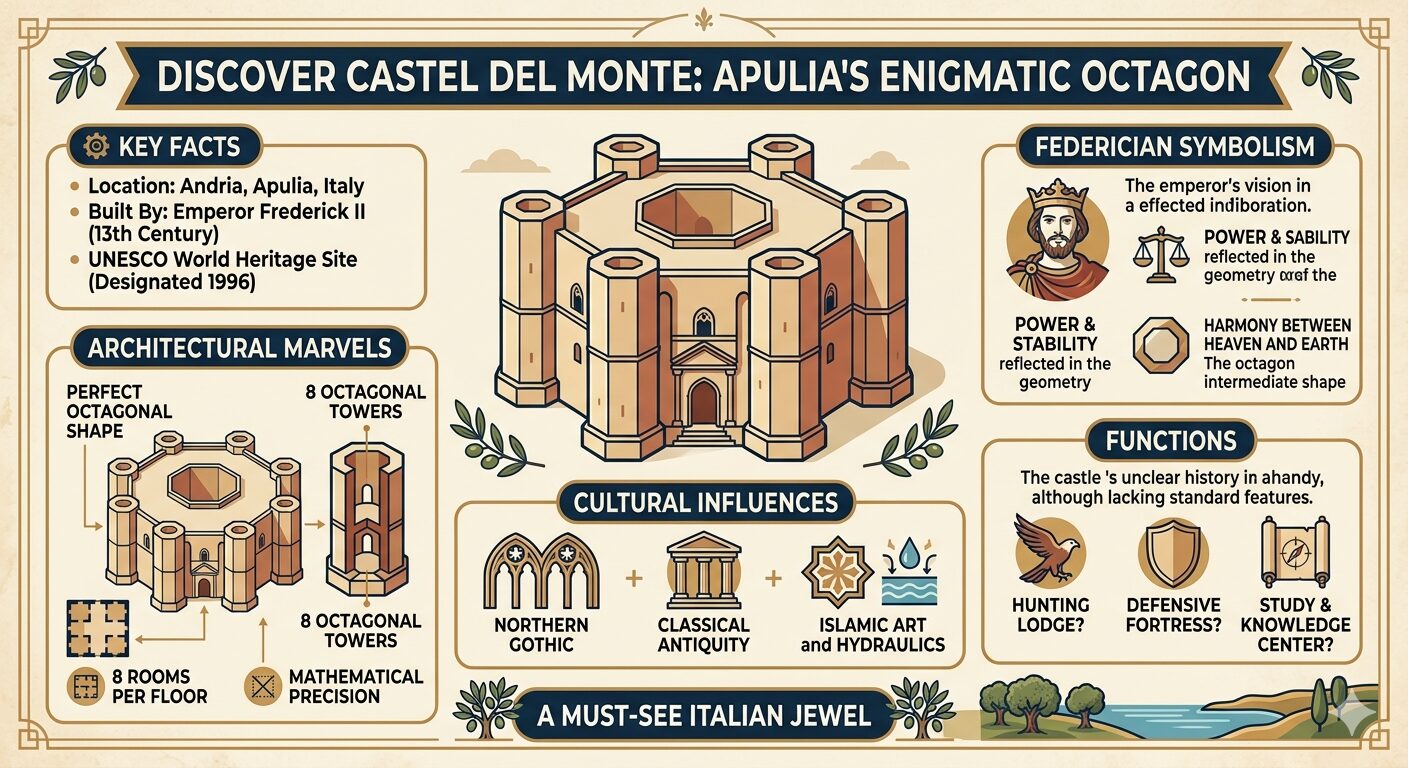
Castel del Monte is a 13th-century citadel and castle situated on a hill in Andria, in the Apulia region of southeast Italy. Built by Emperor Frederick II between 1240 and 1250, it is a UNESCO World Heritage Site and one of Italy’s most iconic landmarks—so much so that it is featured on the Italian 1-cent euro coin. Standing solitary atop a hill in the Murge plateau, Castel del Monte is perhaps the most enigmatic building in all of Italy. Commissioned by Emperor Frederick II in the 13th century, it is a masterpiece of medieval architecture that defies traditional classification. It is not a fortress, nor is it a residence—it is a geometric poem in stone.
The Mystery of the Octagon
The most striking feature of the castle is its obsessive mathematical rigor. The number eight is the absolute protagonist:
The castle has an octagonal plan.
There are eight towers, also octagonal, at each corner.
There are eight rooms on each floor. The octagon is a symbolic shape, representing the intermediate step between the square (the earth) and the circle (the sky/divinity).
Art and Architecture: A Cultural Melting Pot
As a veteran guide, I always emphasize that this castle is a “stone book” of Frederick II’s vision. It blends:
Northern Gothic: Seen in the pointed arches and ribbed vaults.
Classical Roman: Evident in the monumental entrance portal.
Islamic Influence: Reflected in the hydraulic systems and the sophisticated layout of the rooms. The material used is a warm local limestone and coral breccia, which changes color depending on the light—from white to gold and even pink at sunset.
What was it for?
Even today, scholars debate its purpose. There are no moats, no drawbridges, and no stables. Some suggest it was a hunting lodge, others a temple of knowledge or a sophisticated medieval “spa” based on Arabic traditions. Walking through its rooms, you can feel the Emperor’s presence and his quest for a synthesis between East and West.
Logistics for the Modern Traveler
Access: The castle is a UNESCO World Heritage site. You must leave your car in the designated parking lot at the bottom of the hill and take the shuttle bus.
Booking: Advance booking is mandatory especially during peak season, as entry is organized in timed slots.
Wind: Even in summer, the hill can be very windy. Bring a light scarf or jacket.
Tourist Guide Pro Tips
Most people visit only the interior and then leave. Here is my “secret” for a perfect visit:
The Shadow Walk: Walk around the entire perimeter of the castle from the outside. Notice how the light creates different shadows on the octagonal towers; it was designed to function like a giant sundial.
The Courtyard Perspective: Once in the central courtyard, look up. The sky framed by the octagonal walls was intended to be a “window to the infinite.” Try to visit on a clear day to experience this effect.
Local Flavor: After the visit, drive towards Andria and look for a local cheesemaker to try the Burrata di Andria. This world-famous creamy cheese was born right in these hills. Don’t settle for supermarket versions—ask for one made that very morning.
Visitor Information (April 2026)
Opening Hours: Usually open daily from 9:00 AM to 6:30 PM (last entry at 6:00 PM).
Tickets:
Full Price: €10.00
Reduced (18-25 years): €2.00
Booking: It is highly recommended to book in advance via the official website as entry is timed and limited.
Shuttle Service: Visitors must park in the designated parking area at the bottom of the hill (CAT Parking) and take a shuttle bus (€1.00) to the castle entrance, or enjoy a 15-minute uphill walk.
Getting There
By Car: Located about 18 km from the city of Andria (follow the SS170).
By Public Transit: From Bari, take the Ferrotramviaria train to Andria, and from there, take the local bus (Line 6) which runs seasonally to the castle.