The Medici Golden Triangle: Uffizi, Pitti, and Boboli
Welcome to Florence. Take a moment to breathe in the air off the Arno River. You are about to enter the beating heart of the Renaissance. As a guide who has walked these stone corridors for over forty years, I must warn you: do not attempt to “see it all” in one day. It would be like trying to read Dante’s entire Divine Comedy during a coffee break.
The complex we are about to explore—the Uffizi, Pitti, and Boboli—is the ultimate legacy of the Medici family. This is not just a museum visit; it is a journey into the nervous system of Florentine power. The Uffizi represented the center of duty and administration, Palazzo Pitti was the palatial seat of absolute rule, and Boboli was the theater of pleasure, alchemy, and courtly display.
🖼️ 1. The Uffizi Gallery: The Temple of Genius
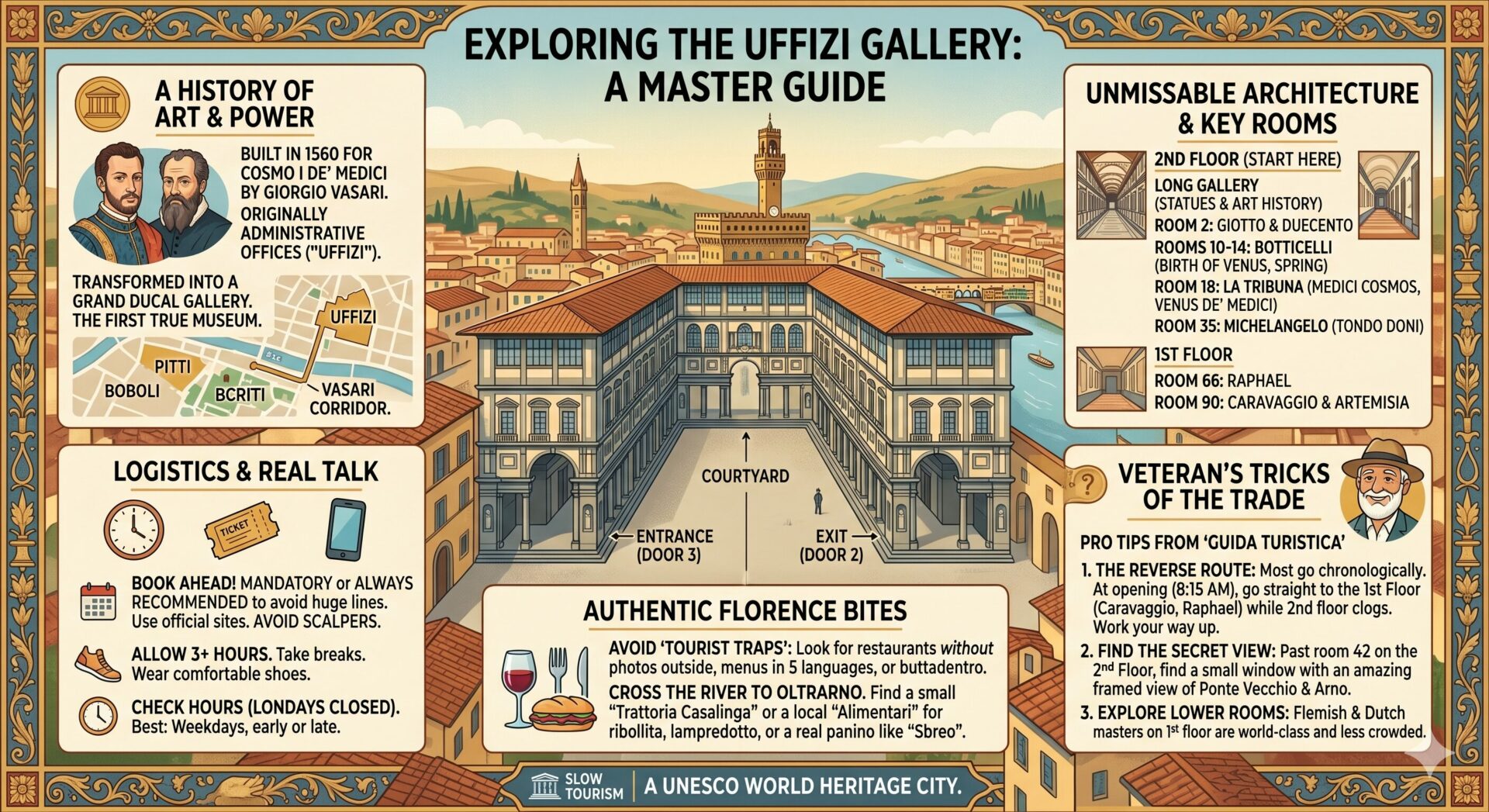
Originally designed by Giorgio Vasari in 1560 as the administrative offices (hence “Uffizi”) to consolidate Cosimo I’s bureaucratic power, it was later transformed into a private gallery by his successors. The chronological route wisely moves backward in time, beginning on the top floor.
🏛️ Second Floor: The Dawn and the Zenith
This is where your journey officially begins. Do not rush straight to Botticelli; you must first understand the evolution of human perception.
- Room 2 (Giotto and the 13th Century): Here you will face three monumental “Maestà” (Enthroned Madonnas) by Cimabue, Duccio, and Giotto.
- The Veteran’s Eye: Look closely at Giotto’s Ognissanti Madonna. Notice how her knees push through the fabric of her dress? For the first time since antiquity, figures have physical weight and occupy real, three-dimensional space. The flat, golden, spiritual realm of the Byzantine era ends here; the modern world begins.
- Room 8 (Filippo Lippi and Piero della Francesca): Lippi’s Lippina (Madonna and Child with Two Angels) is the synthesis of Renaissance grace. Legend has it the Madonna is modeled after Lucrezia Buti, the nun he notoriously eloped with. Opposite this is Piero della Francesca’s Double Portrait of the Dukes of Urbino. Notice the meticulous atmospheric perspective in the background—a clear nod to Flemish painting—and the iconic hooked nose of Federico da Montefeltro, painted in strict profile to hide his missing right eye, lost in a tournament.
- Rooms 10-14 (Botticelli): The intellectual core of the museum. The Primavera and the Birth of Venus are not merely paintings; they are Neo-Platonic manifestos.
- Academic Detail: In the Primavera, botanists have identified over 500 specific plant species. It represents a realm of eternal spring, but also serves as a moral allegory for the young Lorenzo di Pierfrancesco de’ Medici, urging him to choose the path of Humanitas (civilization and virtue) over earthly lust.
- Room 15 (Leonardo da Vinci): The Annunciation perfectly demonstrates Leonardo’s sfumato (the smoky blurring of edges) to depict the thick, moisture-heavy air between the angel and Mary. Also, look at the Baptism of Christ: the leftmost angel, painted by a teenage Leonardo while apprenticing under Verrocchio, is so vastly superior in its lifelike grace that Verrocchio reportedly put down his brushes and vowed never to paint again.
- Room 18 (The Tribuna): A breathtaking octagonal jewel box designed by Bernardo Buontalenti. It represents a cosmic microcosm of the four elements: the red walls (Fire), the weather vane lantern (Air), the pietra dura marble floor (Earth), and the mother-of-pearl dome (Water). It housed the Venus de’ Medici and was the absolute inner sanctum of the Medici collection.
- Room 35 (Michelangelo): Here reigns the Doni Tondo, Michelangelo’s only universally accepted panel painting.
- The Veteran’s Eye: Notice the cangiantismo—the striking, iridescent shifts in the color of the robes—and the complex, twisted pose of the Holy Family (figura serpentinata). This single painting contains the entire genetic code for both the Sistine Chapel ceiling and the birth of the Mannerist movement.
🏛️ First Floor: Grace, Color, and Drama
After a mandatory coffee break, descend to witness the maturity and eventual dramatic rupture of Renaissance art.
- Room 66 (Raphael): The Madonna of the Goldfinch is the absolute perfection of pyramidal composition. Raphael absorbs Leonardo’s lessons but executes them with a serene, unparalleled sweetness. Do not miss his Self-Portrait: a timid gaze that conceals an epoch-defining genius.
- Room 83 (Titian): The Venus of Urbino. She is no mythological goddess; she is a real, sensual woman looking directly into your eyes. This room marks the triumph of Venetian colore (color and brushwork) over Florentine disegno (drawing and precise form).
- Room 90 (Caravaggio & Artemisia): Here, the idealized light of the Renaissance is extinguished, replaced by theatrical chiaroscuro. Caravaggio’s Medusa (painted on a parade shield) will freeze your blood, while his Bacchus offers a melancholic, slightly decaying toast. Next to him is Artemisia Gentileschi’s Judith Slaying Holofernes. It is not just a biblical scene; it is a visceral, feminist revenge painted with ferocious talent by a woman who survived a highly publicized trauma.
💡 The Veteran’s Trade Secret (Uffizi):
The Breathing Strategy: Most tourists suffer museum fatigue after two hours. Go straight to the Second Floor, deeply analyze Rooms 2 through 35, and then stop at the Cafeteria above the Loggia dei Lanzi. The panoramic view over Piazza della Signoria and Palazzo Vecchio will recharge your senses, allowing you to tackle the First Floor (Raphael and Caravaggio) without the images bleeding together in your mind.
🏰 2. Palazzo Pitti: The Royal Palace of Oltrarno
Purchased in 1549 by Eleonora of Toledo (Cosimo I’s brilliant Spanish wife) from the bankrupt Pitti family, it became the official residence of the Grand Dukes. It is the most imposing, fortress-like palace in Florence.
The Unmissable Sections:
- The Palatine Gallery: The paintings here are not hung chronologically but decoratively, in a “quadreria” style, exactly as the Medici and Lorraine families left them. Seek out the astonishing concentration of Raphael masterpieces (the Madonna della Seggiola is a miracle of circular composition, adapting perfectly to its tondo frame).
- The Treasury of the Grand Dukes (formerly Silver Museum): Often tragically skipped. This ground-floor museum reveals the true liquid wealth of the Medici: breathtaking vases in semi-precious stones (pietre dure), rock crystal, and legendary amber.
- Gallery of Modern Art: Located on the top floor, offering a radically different perspective: the 19th-century works of the Macchiaioli (the Tuscan precursors to the French Impressionists). A breath of earthy realism after so much grandiosity.
💡 The Veteran’s Trade Secret (Pitti):
The Secret of the Palatine: Pay attention to the ceilings! The main enfilade of rooms is dedicated to the planets (Venus, Apollo, Mars, Jupiter, Saturn). Painted by Pietro da Cortona, these elaborate Baroque frescoes narrate the ideal education and apotheosis of a Medici prince. It is a 17th-century masterclass in political leadership painted right above your head.
🌳 3. The Boboli Gardens: The Open-Air Museum
Forget your standard city parks. Boboli is the prototype of the “Italian Garden,” the direct inspiration for the Gardens of Versailles. It is a masterclass in the subjugation of nature to political will.
Places of the Soul:
- The Buontalenti Grotto: A masterpiece of Mannerist architecture and esoteric alchemy. The walls seem to melt, transitioning from rough, unhewn rock to refined, classical sculpture, symbolizing the transformation of raw matter into philosophical gold.
- The Amphitheater: Built in the very quarry that provided the stone for Palazzo Pitti. This was the stage for extravagant court spectacles and the birthplace of early opera. In the center stands a genuine Egyptian obelisk, the only one in Tuscany.
- The Viottolone: The grand, steep avenue of cypress trees descending toward the Isolotto (the Island Basin). It is the most dramatic example of Renaissance perspective applied to landscape design.
💡 The Veteran’s Trade Secret (Boboli):
Legs and Water: Boboli is almost entirely uphill. Many tourists burn out halfway. My advice: power through the climb immediately, heading straight to the Forte Belvedere or the Giardino del Cavaliere at the very top for the panoramic view over the Tuscan hills. Then, leisurely zigzag your way down. Warning: There are very few water fountains, and in summer, the Florentine sun beats down fiercely on the white gravel.