🏛️ Archaeological Area of Sperlonga: The Villa of Tiberius & The Grotto of Odysseus
A Masterpiece of Imperial Luxury and the Hellenistic “Odyssey in Stone”
📜 HISTORICAL & ARCHAEOLOGICAL EVOLUTION
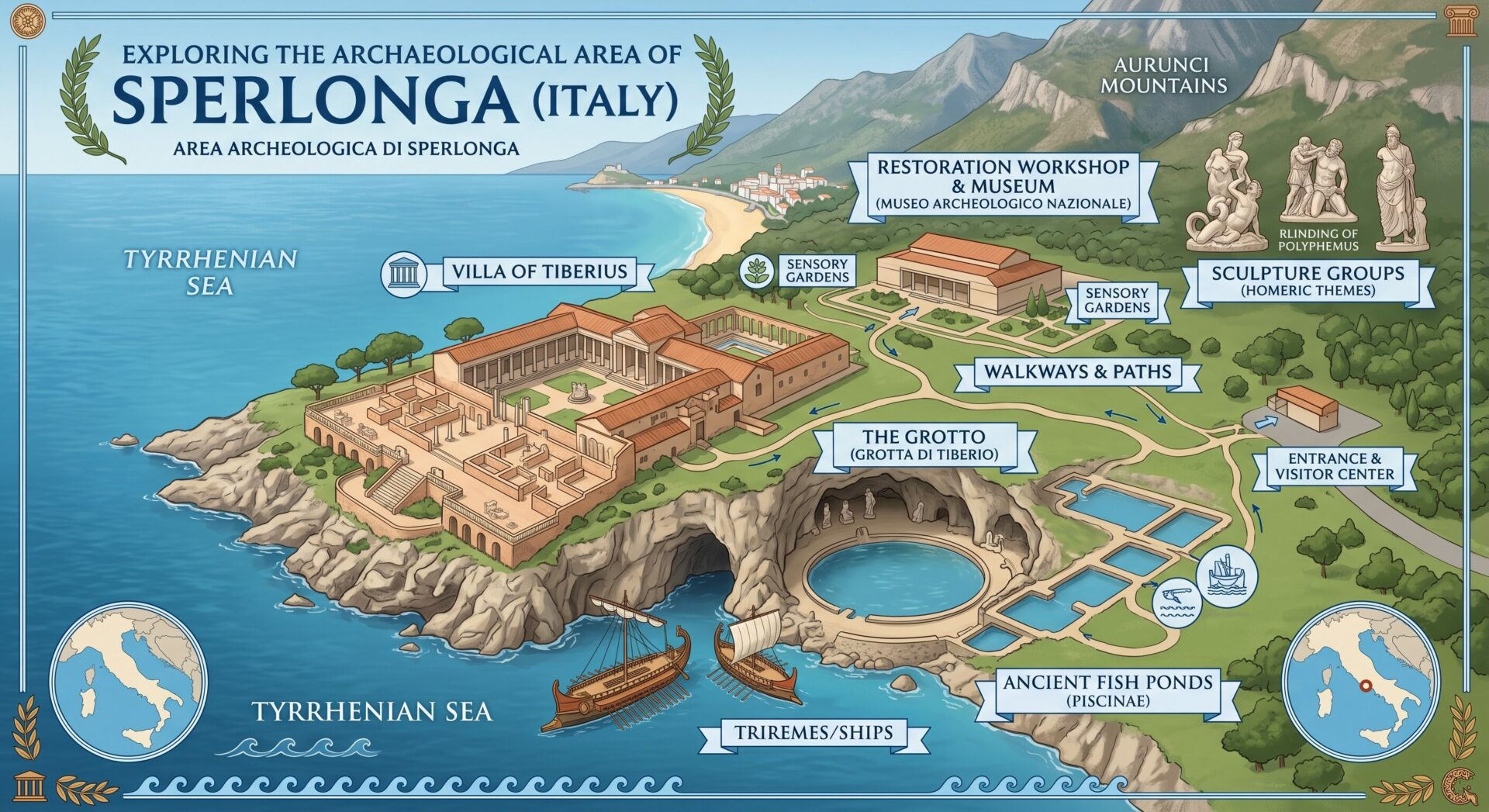
The Archaeological Area of Sperlonga is one of Italy’s most evocative sites, where the Via Appia meets the Tyrrhenian Sea. The complex evolved through distinct phases:
Republican Origins: The site originally hosted a late-Republican residence (1st century BC), possibly belonging to the family of Livia, Augustus’s wife and Tiberius’s mother.
Imperial Grandeur: Under Tiberius (1st century AD), the villa was transformed into a monumental Antrum. A two-naved portico was added, and the natural sea cave was architecturally framed to become the world’s most spectacular summer dining hall.
Political Ideology: The focus on Odysseus was a deliberate choice by the Gens Claudia. By celebrating the hero’s son Telegonus (born of Circe), Tiberius claimed a divine lineage distinct from the Aeneas-focused myth of the Gens Iulia (Augustus).
🌊 THE VILLA STRUCTURE & GROTTO LAYOUT
The villa was a complex organism spread across terraces:
Living Quarters: Included a gymnasium, service rooms, a furnace, and a specialized bakery (pistrinum) to serve the imperial court.
The Grotto’s Engineering: * The Rectangular Basin: A massive saltwater pool with a central island for the caenatio (dining area).
The Circular Basin: A 12m diameter pool inside the cave housing the Scylla group.
Secondary Rooms: To the left, a horseshoe-shaped room for more intimate dining; to the right, a nymphaeum with artificial waterfalls leading to the Polyphemus niche.
The “Navis Argo”: A mosaic inscription marks the presence of the legendary ship, creating a fully immersive narrative for the guests.
🗿 THE HELLENISTIC MASTERPIECES
The “Odyssey in Stone” was designed to surround the guests, making the myths “come alive” through the play of light and water.
The Polyphemus Group: Positioned at the back of the cave, the giant appeared to be lying directly on the natural rock.
The Scylla Group: The monster emerged from the circular basin, devouring six of Odysseus’s companions.
The Palladium & Pasquino: These groups reinforced the link to Rome. The “Odysseus with Achilles’ body” is the superior original of the famous Pasquino statue in Rome.
Ganymede: Originally placed high above the cave’s opening, symbolizing the divine gaze over the imperial banquet.
Tourist Guide Pro Tips
💡 THE VETERAN’S TRICK: LOGISTICS & HIDDEN GEMS
“To truly understand Sperlonga, you must approach it like a Roman Senator: with patience and a taste for the sublime.”
How to Reach the Site:
By Train: Roma-Napoli line to Formia-Gaeta, then the “Cotral” bus to Sperlonga (20 mins).
By Car:Via Flacca. Veteran Tip: Park at the upper town and take the panoramic pedestrian path that descends toward the museum. From this height, the layout of the Roman terraces and the piscinae is perfectly visible—a perspective that reveals the true scale of the site.
The Hidden “Chicca”: Inside the museum, look for the statue of Circe. Since the villa is near her legendary home (Mount Circeo), its presence turns the entire landscape into a living map of the Odyssey.
The Sejanus Incident: In 26 AD, a rockfall during a banquet nearly killed Tiberius. His protector, Sejanus, saved him by shielding him with his body. This event eventually turned the luxury villa into a more austere barracks.
🛠️ PRACTICAL WISDOM & BOOKING
The Visit Sequence: Start at the Museum to study the fragments, then walk down to the Grotto to see their original “stage.”
Optimal Timing: The “Golden Hour” (90 mins before sunset) is essential. The light reflecting off the basins into the cave creates the same atmosphere Tiberius enjoyed 2,000 years ago.
Accessibility: The site is largely accessible via a paved slope.
For bookings and customized itineraries: Contact Italian Travel Team 📧 info@italiantravelteam.comExpertise and passion for the Italian heritage.
“Vedi Sperlonga e poi… capirai perché Tiberio non voleva più tornare a Roma.”