Located in Stra, along the scenic Brenta Canal, Villa Pisani is the most imposing and famous of all the Venetian Villas. Built in the 18th century, it is a monument to the power of the Pisani family and a witness to the shifting tides of European history.
🏛️ History: A Doge’s Palace on Land
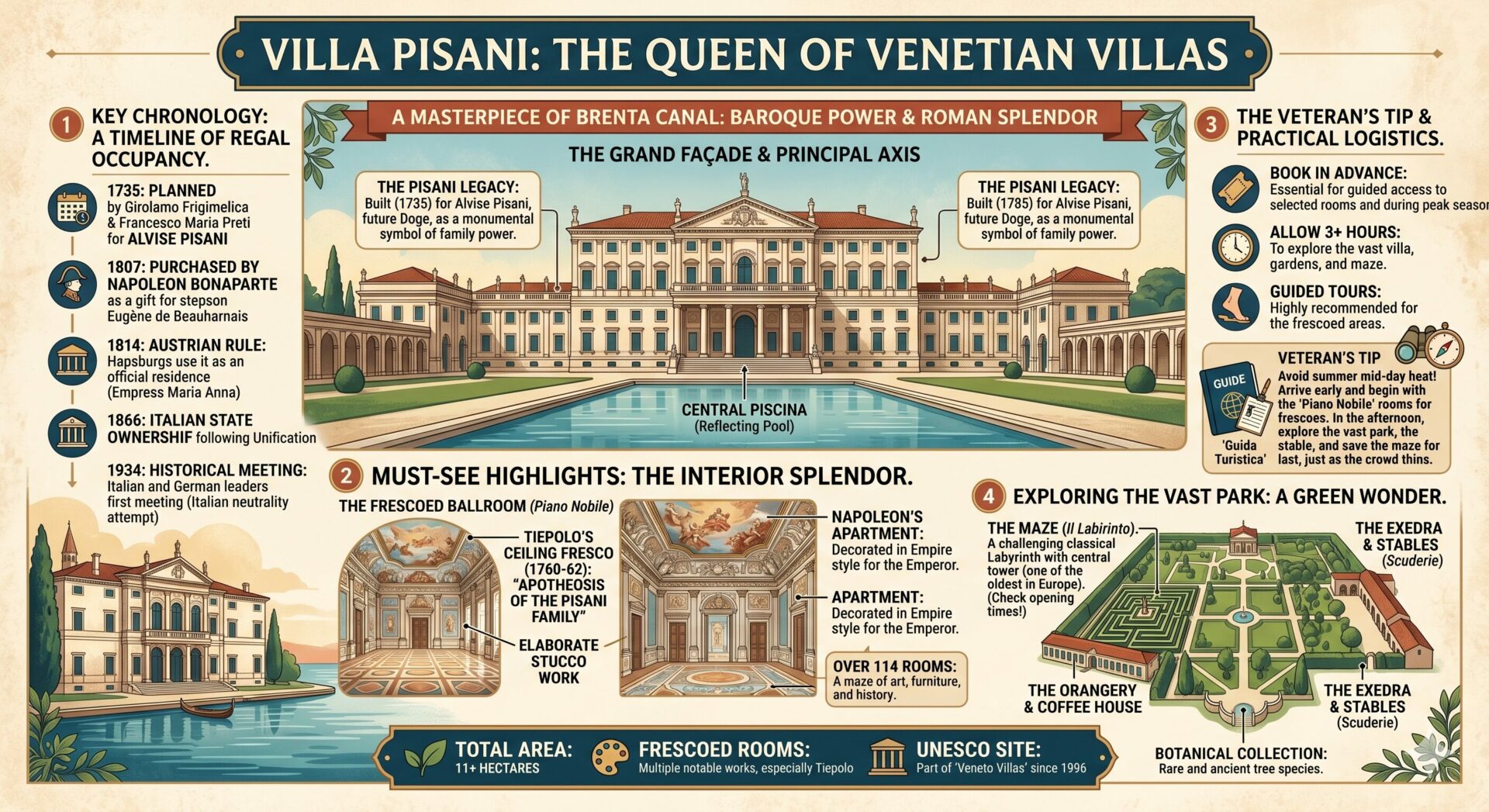
The villa was commissioned in 1735 by the noble Pisani family to celebrate the election of Alvise Pisani as the 114th Doge of Venice. While most Venetian villas were functional farming estates, Villa Pisani was built for pure prestige and political representation.
Architectural Grandeur: The original project by Girolamo Frigimelica was completed by Francesco Maria Preti. The result is a massive, H-shaped building with a facade reminiscent of a Roman palace, complete with giant-order columns and statues.
The Napoleonic Era: After the fall of the Venetian Republic, the villa was sold to Napoleon Bonaparte in 1807. It became an imperial residence, and today you can still visit the “Empire Style” rooms where Napoleon himself stayed.
The Austrian and Italian Periods: Later, it passed to the Hapsburgs and finally to the Italian State in 1866, following the unification of Italy.
🎨 Masterpieces of Art
The villa is essentially an art gallery of the 18th century.
Tiepolo’s Masterpiece: The most famous room is the central Ballroom. The ceiling features the breathtaking fresco “The Apotheosis of the Pisani Family” (1761-1762) by Giambattista Tiepolo, the last great master of the Venetian school. It depicts the family surrounded by allegorical figures, soaring into the heavens.
114 Rooms: Legend says there are 114 rooms to honor Alvise Pisani being the 114th Doge. Each is decorated with original furniture, tapestries, and stuccos.
🌿 The Park and the Famous Labyrinth
The park covers 11 hectares and is a masterpiece of garden design.
The Maze (Il Labirinto): This is one of the most famous and difficult historical mazes in Europe. Originally made of hornbeam hedges, it features a central tower with a double spiral staircase. In the 18th century, it was used for courtly games of “hide and seek” and flirtation.
The Great Pool: The long reflecting pool in front of the stables was actually built in the early 20th century for hydraulic experiments, but it fits the Baroque scale of the garden perfectly.
The Coffee House: A charming 18th-century structure built on a small hill, offering a panoramic view of the grounds.
Tourist Guide Pro Tips
🚶 Veteran’s Practical Advice
Booking the Maze: Access to the Labyrinth is often restricted by time slots and weather conditions (it closes if it’s too wet or hot). Check at the ticket office immediately upon arrival to see the schedule for the day.
Visit Order: Start with the Villa’s interior when your mind is fresh for the art, then spend the rest of your time in the park.
Transport: If you are coming from Venice, the “Burchiello” boat tour is the classic way to arrive, but the local 53E bus is a faster and cheaper alternative.
💡 Il Trucco del Mestiere (The Veteran’s Tip)
“Many visitors rush through the ballroom, look up at the ceiling, and leave. Here is my secret: Look at the mirrors. The ballroom was designed to be used for grand gala dances at night. The mirrors are angled specifically to reflect the candlelight onto Tiepolo’s fresco above, making the clouds seem like they were moving in the flickering light. Even during the day, if you stand near the walls and look at the ceiling through the reflection in the mirrors, you get a different, almost dizzying perspective of the depth Tiepolo achieved.”
Position: Situated about 10 minutes from Padua and 20 minutes from Venice.
Transport: Easily reachable from Padua via Busitalia Veneto (line E073). It is also a key stop on Burchiello river cruises traveling between Venice and Padua.
Visiting Details
Built: Started in 1721 by Gerolamo Frigimelica and finished by Francesco Maria Preti. It features 114 rooms to honor Alvise Pisani, the 114th Doge of Venice.
Guided Visits: Private and group tours are available, often focusing on the Ballroom’s ceiling fresco, a masterpiece by Giambattista Tiepolo. Digital audio guides are also available on-site.
Opening Hours: Typically 9:00 AM – 7:00 PM (April–September) and closing earlier at 4:00 PM (October–March). The museum is generally closed on Mondays.
Top Tips
The Labyrinth: Conquer the famous hedge maze, one of the most intricate in Europe. Note: It may be seasonally closed or under restoration, so check the official status before arriving.
Napoleon’s Room: Visit the original apartment where Napoleon stayed, featuring period furniture and his personal bed.
The Stables: Walk to the far end of the 14-hectare park to see the grand stables, which reflect beautifully in the long central water basin.
Free Admission: Visit on the first Sunday of the month for free entry as part of Italy’s “Domenica al Museo” initiative.
Comfort: Wear walking shoes; the estate covers over 27 acres. [1, 2, 3, 4, 5, 6, 7, 8, 9]
🍽️ Nearby Refreshments
Avoid the “fast food” stands right at the entrance. Walk five minutes toward the center of the village of Stra. Look for a local osteria along the canal and order a “Cicchetto” (Venetian tapa) with a glass of local Friularo wine. It’s the perfect way to soak in the atmosphere of the Brenta Riviera.