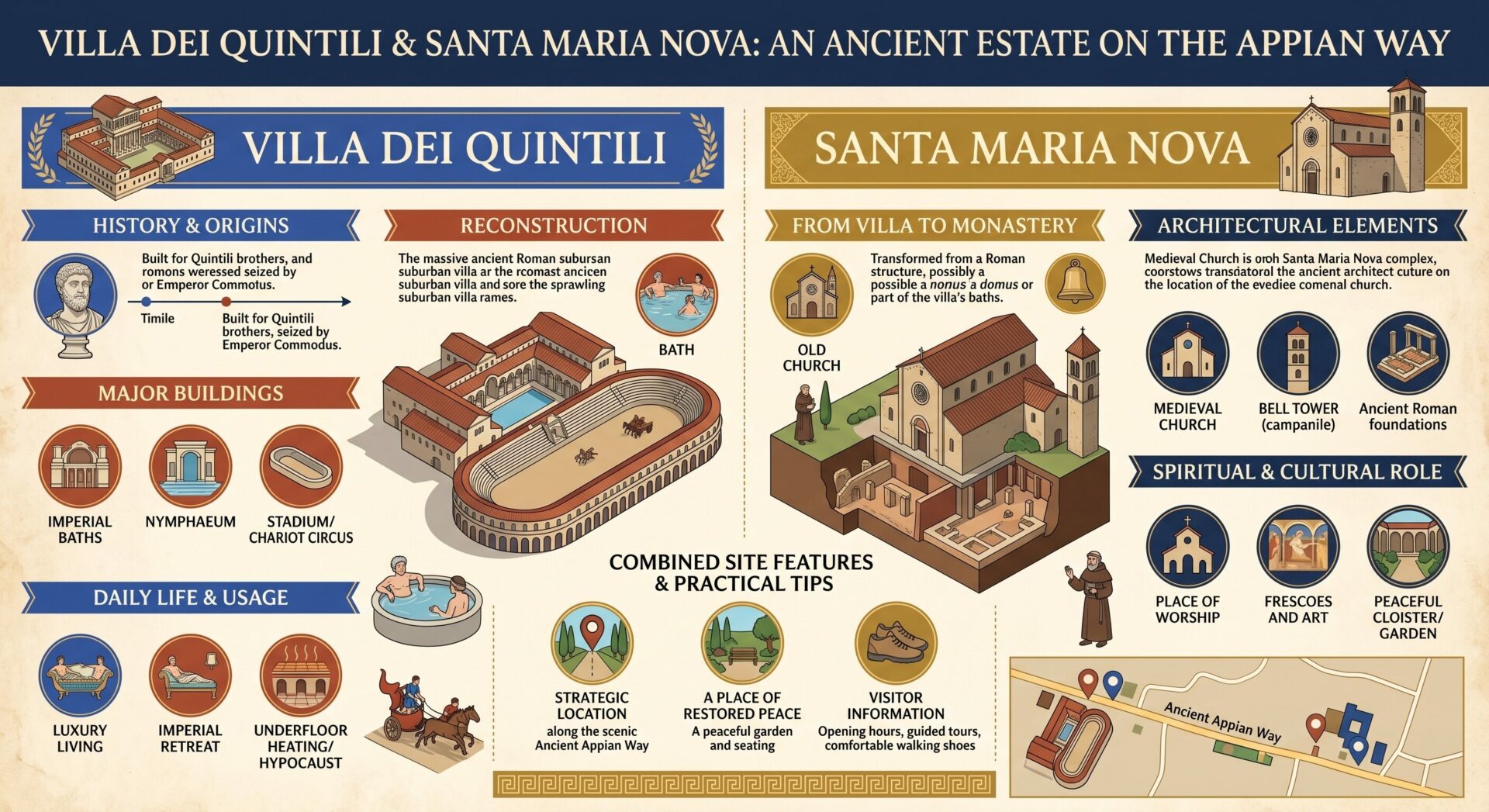
The Villa of the Quintili is the largest residential complex in the Roman suburbs. Located between the 5th mile of the Via Appia Antica and the 7th kilometer of the Via Appia Nuova, it sits on a volcanic ridge offering a panoramic view of the Alban Hills.
1. Historical Profile and Ownership
Origins (2nd Century AD): The original core dates back to the late Hadrianic period (first half of the 2nd century).
The Quintili Brothers: Thanks to the discovery of lead water pipes (fistulae aquariae), the estate was attributed to two noble brothers who served as consuls in 151 AD.
Imperial Acquisition: In 182-183 AD, Emperor Commodus, coveting their immense wealth, accused them of conspiracy and had them executed, transforming the property into an imperial villa.
Medieval Evolution: During the Middle Ages, the complex was repurposed as a castrum (fortification).
2. Architecture and Main Sectors
The villa was a luxurious “pavilion-style” residence divided into several functional nuclei:
Sector
Description and Functions
Residential
Divided into private quarters (cubicula) and state rooms used for reception, featuring lavish marble wall coverings.
Baths
Includes the Frigidarium (cold water), Tepidarium (transition), and Calidarium (hot water with massive windows).
Entertainment
A small amphitheater (ludus) for Commodus’ training and a theater converted from a former summer dining room (triclinium).
Water Systems
Featured a dedicated aqueduct, large cisterns (including the circular “Piranesi” cistern), and a monumental nymphaeum.
3. Key Points of Interest
Monumental Nymphaeum (H): Originally the entrance from the Via Appia Antica, it was a dramatic fountain decorated with statues, including the Niobe.
The Amphitheater (F): Built in the late 2nd century for Commodus’ gladiatorial ambitions, it was later converted into a garden (viridarium) in the 3rd century.
Xysta: Heated porticoed corridors (with approximately 19 rooms) used for indoor running/exercise.
“Piranesi” Cisterna (Q): A circular building 29 meters in diameter (100 Roman feet), named after an engraving by the famous architect Giambattista Piranesi.
4. Santa Maria Nova Estate
Acquired in the Late Middle Ages by the Olivetan monks, this estate includes a farmhouse built directly on top of a Roman cistern.
The Guard Baths: Located in front of the farmhouse, these are the remains of a thermal bath complex featuring mosaics of gladiatorial scenes (nets, tridents) and horse races.
Roman Appian Way: Near the farmhouse, a stretch of the original Roman basalt paving of the Via Appia Antica is visible.
5. The Antiquarium
Located at the site’s entrance, it houses artifacts testifying to the villa’s ancient splendor:
Statue of Zeus Bronton: A colossal sculpture of the “thundering” god.
Statue of Niobe: Discovered in 2005 near the Nymphaeum.
Hydraulic Engineering: Remains of ancient piping that formed part of the villa’s massive water supply system.
Study Tip: To better understand the spatial layout of the site, watching 3D video reconstructions is highly recommended.
Tourist Guide Pro Tips
🕒 Practical Logistics (Real Talk)
The Double Entrance: This is vital. You can enter from Via Appia Nuova 1092 (easier by car or bus) or from Via Appia Antica.
Booking: While not as crowded as the Colosseum, I always recommend checking the Parco Archeologico dell’Appia Antica official site. In 2026, many state sites have moved toward digital-only ticketing or mandatory time slots.
The Hike: This site is massive. We are talking about 24 hectares. Wear “scarpe comode” (comfortable shoes)—this is not the place for fashion over function.
🍴 Authentic Eats (Where the Romans Go)
Avoid any place with a waiter standing outside waving a menu. Instead, try:
Antica Roma (Via Appia Antica): A bit more upscale, but you are dining in a historic setting that feels authentic to the surroundings.
Hostaria del Parco: Located nearby in the Statuario neighborhood. It’s where local families go for a Sunday roast or a plate of Amatriciana. No bells and whistles, just flavor.
💡 The “Pro” Tip (Il Trucco del Mestiere)
The “Reverse Entry” Strategy: Most tourists take the bus to the Appia Nuova entrance because it’s “easier.” Don’t do that. > Instead, take a taxi or the 118 bus to the Appia Antica side. Enter the villa from the ancient road. Why? Because the walk from the Appia Antica gate up toward the main core of the villa offers a dramatic, rising perspective that the architects intended for guests 2,000 years ago.
Extra Secret: Look for the small museum on-site (the Antiquarium). Most people skip it because they are tired of walking, but it contains the colored marbles and statues actually found on-site. It turns the “grey ruins” back into a technicolor palace in your mind.
Combined Ticket: Take advantage of the combined ticket (“Appia Card”) which often includes other sites along the Via Appia Antica (like the Mausoleum of Cecilia Metella).
Entrances: There are two main entrances: Via Appia Nuova (easier for cars/parking) and Via Appia Antica (more scenic for walkers). You can enter from one and exit from the other.
Timing: The site is vast and mostly outdoors. Visit during the early morning or late afternoon to avoid the midday sun and enjoy the best light for photography.
Footwear: Wear comfortable walking shoes. The terrain is uneven and includes original Roman basalt paving (basolato).
Restoration Areas: Some areas, like the mosaics at Santa Maria Nova, might be under restoration. Check the official park website for current accessibility updates.