I.T.T. Italian Travel Team - Rome, Italy - Phone: +39 0656567830 - Mail: info @ italiantravelteam.com
Area Archeologica Altino

Altino

Listen to the Guide

Duration: 52.12 - Narrated in English

Altinum: The Breath of the Ancient Lagoon

While the “calli” of Venice echo with the footsteps of millions of tourists, just a few kilometers away, amidst cornfields and the fishing valleys of Quarto d’Altino, lies a ghost city. Altino is not just an archaeological site; it is the mother of Venice, a place where geography has written history.

🏺 Origins and Foundation: The Horse People

Long before the arrival of Rome, Altino was already a nerve center for the Paleoveneti (10th–9th century BCE). Its strength was its position: a perfect “harbor-canal,” protected by the lagoon but open to inland trade. Ancient writers tell us that the best horses of the ancient world were bred here. It wasn’t just a matter of land, but of mud and water: the Veneti knew how to master the hydraulics of a challenging territory.

🏛️ The Roman Period: The Emporium of the North

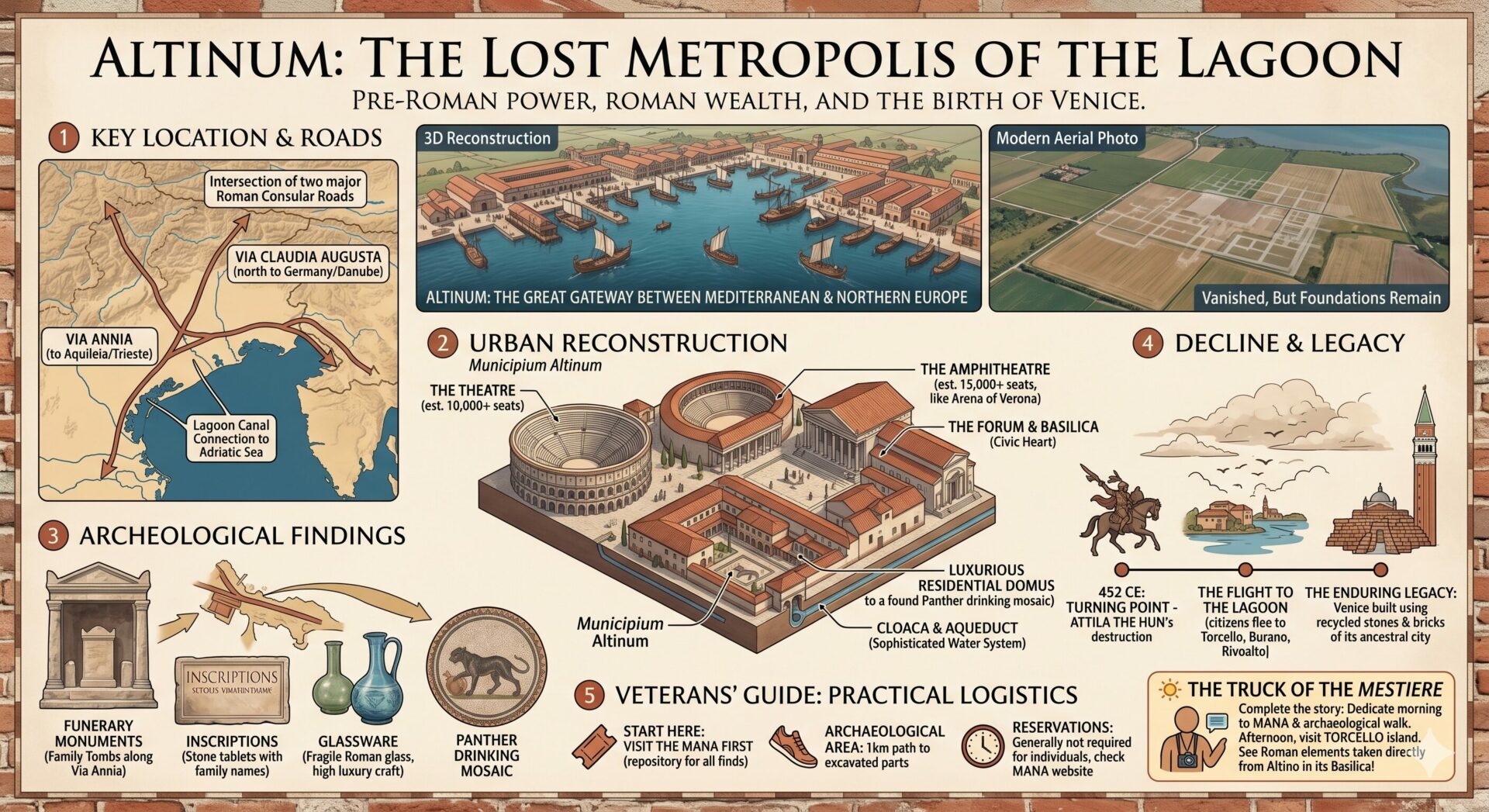
Under Rome, Altinum became a Municipium of incredible wealth. Imagine a city of 20,000 people where today you see only fields.

  • Strategic Logistics: This was the intersection of the Via Annia (leading to Aquileia) and the Via Claudia Augusta (crossing the Alps toward Germany). It was the Empire’s gateway to the North.
  • Luxury Leisure: Martial and Pliny praised the villas of Altino, comparing them to those of Baia (Naples). They produced high-quality wool, refined glass, and lived in houses decorated with mosaics that would make today’s Venetian palaces envious.

⚔️ The Shadow of Attila and the Great Exodus

The year 452 CE marked the end of the dream. Attila the Hun, after razing Aquileia to the ground, set his sights on Altino. The city was devastated, but it wasn’t just the Huns’ swords that killed it. It was fear. The inhabitants began to realize that the mainland was no longer safe. Slowly, over two centuries, the population shifted toward the lagoon islands: Torcello, Burano, Mazzorbo, and finally Rivoalto (Venice).

Historical Note: Venice was not born from nothing; it is literally built with the bricks of Altino. For centuries, the ruins of the Roman city were used as a “quarry” for ready-made materials to build the basilicas of Torcello and the Venetian palaces.

🔭 The Archaeology of the Invisible

Today, Altino is famous in the scientific world for aerial archaeology. Since the city was never overwritten by modern centers, during major droughts, the traces of streets, the theater, and the amphitheater appear in grain fields like “ghosts” visible only from above. It is a city sleeping under just a few centimeters of earth.
Tourist Guide Pro Tips

🚶 Guided Visit: Top Travel Tips & Practical Advice

To truly appreciate Altino, you need to understand the logistics. This isn’t a place for a “quick stop”; it’s a place for contemplation.

  • The MANA First Policy: Your visit must start at the National Archaeological Museum of Altino (MANA). It is a beautiful, modern structure. Without seeing the artifacts and the 3D reconstructions inside, the empty fields outside will remain just fields. The panoramic terrace is the best place to orient yourself.
  • The Archaeological Path: After the museum, take the 1km walk to the outdoor ruins. You’ll see a residential gate, the Roman road (Via Annia), and the foundations of a massive gate.
  • Timing is Everything: Visit in the late spring or early autumn. The light is softer, the mosquitoes of the lagoon are less aggressive, and the colors of the cultivated fields make the “ghostly” outlines of the buried city easier to imagine.
  • The “Hidden” Boat Route: If you are staying in Venice, don’t take the train/bus. Hire a small private boat (a bragozzo) from Torcello or Burano to take you through the salt marshes (barene) directly to the Altino pier. It is the most evocative way to arrive, following the same route the refugees took 1,500 years ago.

💡 The Trick of the Trade

“Many people visit Altino and then go straight home. That’s a mistake. If you want to close the circle, after the museum, go to Torcello. Look for the Basilica of Santa Maria Assunta. Examine the columns and the marbles: many of those 7th-century architectural elements come directly from the forum of Altino. It is there that you will understand that Altino didn’t die; it simply moved onto the water. Also, look for the ‘Devil’s Bridge’ in Torcello—it’s made of the same Roman-style bricks you just saw in the Altino excavations.”

🍽️ Food & Wine: The Taste of the Valley

In this area, do not look for “tourist” seafood. Here, valley cuisine (cucina di valle) reigns supreme.

  • Recommendation: Look for a trattoria along the Sile river or near the museum. Ask for “Pesce di Valle” (grey mullet or sea bream grilled over embers). The flavor is distinct from sea-caught fish—earthy and rich.
  • The Seasonal Gem: If you visit in May, ask for the castraure (the first, tender violet artichokes of the lagoon). They are a local obsession.
  • To Drink: A glass of Orto di Venezia (a wine actually grown on the lagoon islands) or a structured Raboso del Piave if you prefer red.

🌿 Sustainability and Respect

Altino is a fragile ecosystem.

  • Slow Travel: Reach the museum by bicycle along the Sile cycle path (the “Greenway”). It’s a flat, scenic ride that prepares your mind for the ancient pace of life.
  • Respect the Silence: This was once a city of 20,000 souls. Treat the walk through the fields with the same respect you would show a cathedral.
The easiest way to reach the National Archaeological Museum and Site of Altino from Venice is by bus or car, as the museum is located in the hamlet of Altino, about 4 km away from the main train station of Quarto d’Altino. [1, 2, 3, 4]
🚌 By Public Transport (Best Option)
Taking the bus is the most direct way to get within walking distance of the museum entrance.
    • Direct Bus: From Venice (Piazzale Roma) or Mestre Railway Station, take the ATVO bus (Line 25A) heading towards San Donà di Piave.
    • Stop: Get off at the Altino – Museo stop.
    • Travel Time: Approximately 45–50 minutes.
    • Walk: It is about a 9-minute walk from the bus stop to the museum. [1, 2, 3, 4, 5]

🚆 By Train
If you prefer the train, you will need to complete the last leg of the journey by taxi or a local bus.
    • Train: Take a regional train from Venezia Santa Lucia or Mestre to Quarto d’Altino station (about 15–30 minutes).
    • Onward Journey: The museum is about 4 km from the station. You can take a local bus (Line 9E) or a taxi from outside the station. [1, 2, 3, 4]

🚗 By Car
This is the fastest method, especially if you are coming from the airport.
    • Route: Follow the Via Orlanda or country roads towards Quarto d’Altino.
    • Travel Time: About 20–25 minutes from Venice.
    • Parking: There is a free parking lot located directly behind the museum buildings. [1, 2, 3, 4]

🚲 By Bicycle
Altino is a popular stop for cyclists. It is located at the intersection of the Via Annia and Via Claudia Augusta Roman roads and is part of the Sile River Regional Park cycling network.

Villa Quintili e S. Maria Nova

lazio

Palazzo Giustiniani

lazio

Pantheon

lazio

Luni

liguria

Crespi D'Adda

lombardia

Urbs Salvia

marche

Castel del Monte

puglia

Area Archeologica Roselle

toscana

Pienza

toscana

Galleria degli Uffizi

toscana

Necropoli del Crocifisso

umbria

I.T.T. Italian Travel Team srl
Via Alberto Ascari 212
00142 Roma, Italy
p.iva 07667701002

Copyright © 2026 powered by Italian Travel Team. All rights reserved

error: Content is protected !!