The Orto Botanico di Padova: Where Science Meets Nature
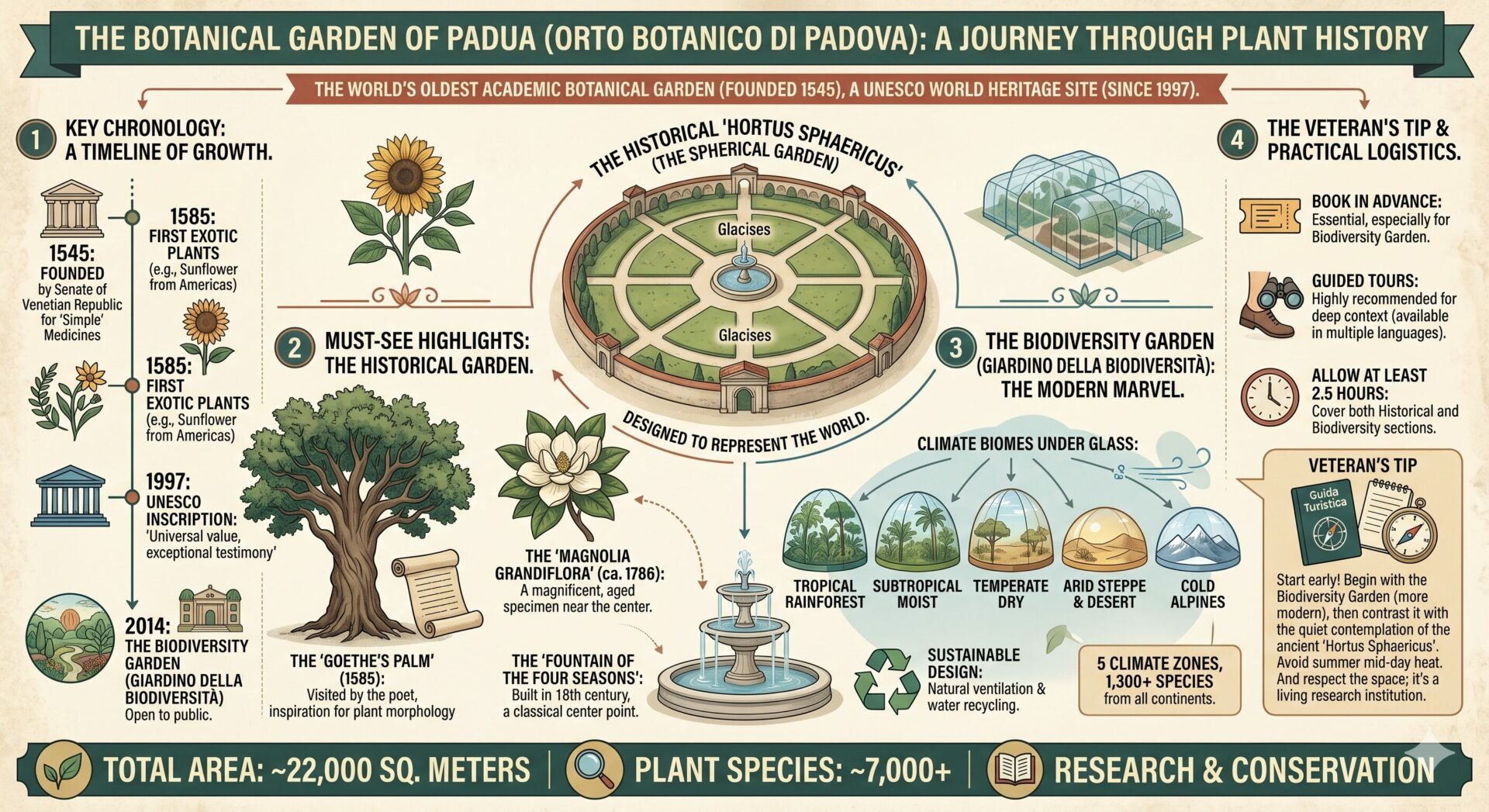
The Orto Botanico di Padova (University of Padua Botanical Garden) is the world’s oldest academic botanical garden, founded in 1545. Recognized for its immense historical and scientific value, it has been a UNESCO World Heritage site since 1997.
Established by the Senate of the Venetian Republic, it was originally a “Hortus Simplicium” (Garden of Simples)—a place to grow medicinal plants for the University’s medical students. Today, it stands as a breathtaking testament to biodiversity and scientific evolution.
🏛️ The “Hortus Sphaericus”: The Renaissance Heart
The core of the garden is a perfect circle, representing the world, inscribed within a square. This geometry wasn’t just aesthetic; it reflected the Renaissance belief in a harmonious universe.
The Circular Wall: Built in 1552 to stop the frequent nighttime thefts of precious medicinal plants.
The Four Gates: Facing the cardinal points (North, South, East, West), inviting the knowledge of the world into this sacred space.
The Fountains: The “Fountain of the Four Seasons” at the center provides the constant murmur of water, essential for both irrigation and contemplation.
🌿 Living Legends: Plants You Cannot Miss
As a guide, I always tell my guests that these plants are the “elder statesmen” of the garden:
Goethe’s Palm (planted 1585): The oldest plant in the garden. The great German poet Wolfgang von Goethe saw it in 1786 and it inspired his revolutionary theories on the metamorphosis of plants. It is housed in its own octagonal greenhouse.
The Plane Tree (planted 1680): Located near the entrance, with a hollow trunk that tells the story of centuries of survival.
The Ginkgo Biloba (planted 1750): A “living fossil” that turns a magnificent gold every autumn.
🌍 The Biodiversity Garden: A Leap into the Future
In 2014, the garden expanded with a massive, high-tech glasshouse structure. This is a journey through the Earth’s biomes:
Tropical Rainforest: High humidity and exotic giants.
Sub-humid/Temperate: The Mediterranean and beyond.
Arid/Desert: The beauty of survival in extreme heat.
Polar/Alpine: Rare plants from the world’s coldest reaches.
The Greenhouse Tech: The building is entirely sustainable, using natural ventilation, solar power, and rainwater recycling
Tourist Guide Pro Tips
💡 Il Trucco del Mestiere (The Veteran’s Tip)
Guided Visits & Tools
Guided Tours: Available in English (as well as Italian, French, and German).
Duration: Roughly 90 minutes.
Booking: Highly recommended.
Web-Audio Guide: You can access a digital audio guide on your smartphone via QR codes throughout the garden.
Botanical Museum: Opened in 2023, the museum showcases historical herbaria and scientific instruments.
Top Tips for Your Visit
See “Goethe’s Palm”: Planted in 1585, it is the garden’s oldest resident. It inspired the poet Goethe’s theories on plant metamorphosis.
Explore the Biodiversity Garden: Don’t miss the 15-meter-high greenhouses; they are a striking architectural contrast to the 16th-century walls.
Check the Season: Some plants, like the giant Victoria amazonica water lilies, are only in bloom during summer months.
Timing: Allow at least 2 to 3 hours to see both the old gardens and the new greenhouses.
Opening Hours: Times vary by season (usually 9:00 AM to 5:00 PM or 7:00 PM). It is typically closed on Mondays (except holidays).
🚶 Veteran’s Practical Advice
Ticketing: I strongly recommend booking online in advance, especially on weekends. It is a popular site for both locals and scholars.
The Best Route: Start with the modern Biodiversity Garden first. It’s a sensory explosion. Then, walk back in time to the quiet, stone-walled Historical Garden for a moment of reflection.
Timing: Avoid the midday heat in July and August. Even with the shade, the humidity in the greenhouses can be intense. Early morning (9:00 AM) is best.
“Most visitors ignore the Botanical Museum located within the complex. Don’t make that mistake. It houses incredible herbaria and the ‘Pharmacy’ of the 18th century. But here is the real secret: look for the ‘Library of the Garden’. It holds one of the world’s most important collections of botanical books. If you ask nicely at the desk, sometimes you can see the temporary exhibits of ancient illustrated manuscripts. It is where you truly understand that botany was the first global ‘internet’ of information.”
🍴 Nearby Refreshments
After your visit, walk two minutes to Prato della Valle, one of the largest squares in Europe. Find a small “Bar” under the porticos and order a “Spritz Bianco” (with still white wine and lemon) and a “tramezzino” (crustless sandwich). It’s the true Paduan way to recover your energy.