Minturnae: The Silent Giant on the Appian Way
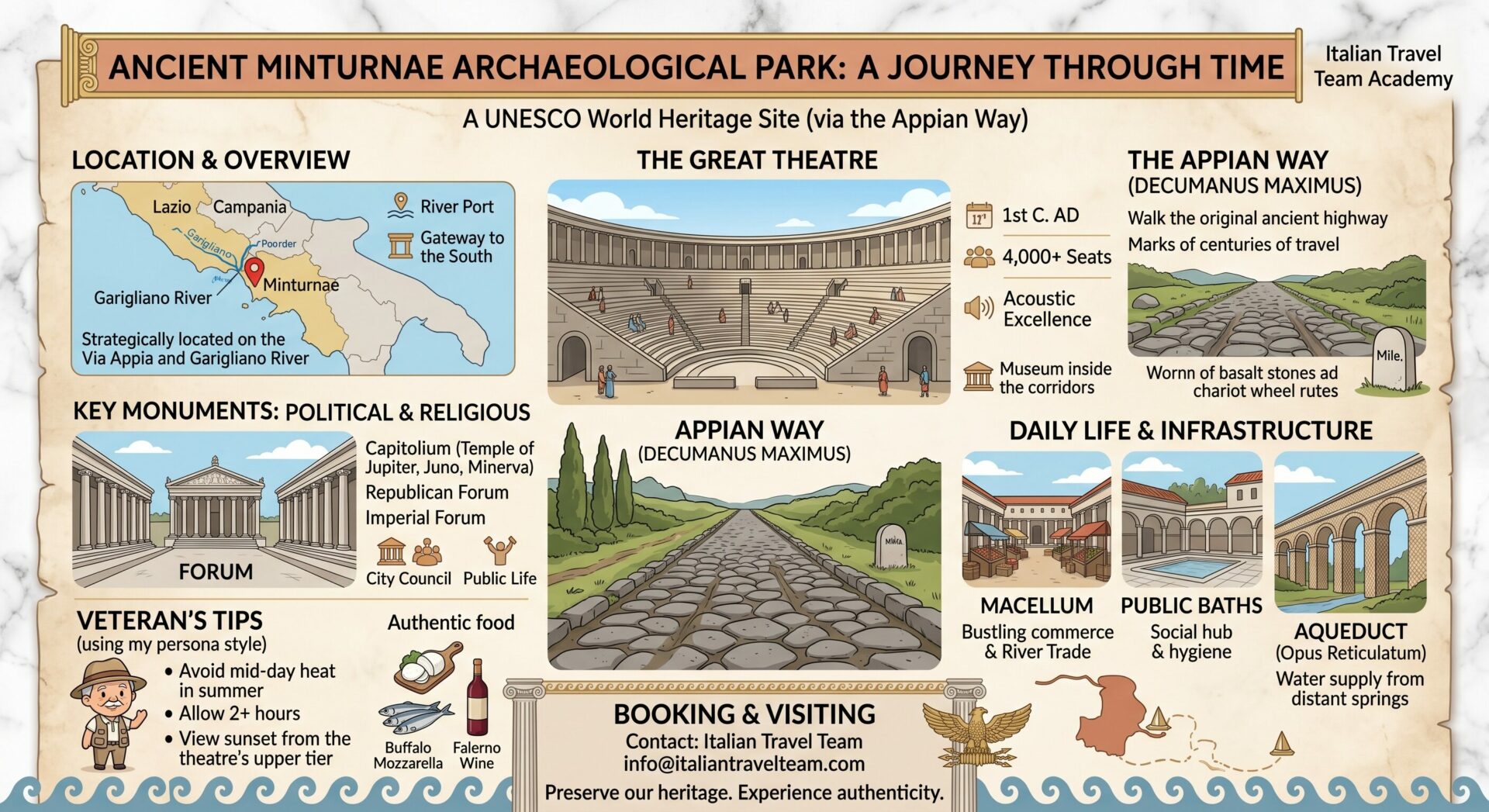
Welcome to the “Gateway to the South.” The Archaeological Park of Minturnae is not merely a collection of Roman stones; it is a complex palimpsest of life, trade, and engineering, rising precisely where the Garigliano River meets the Tyrrhenian Sea. In 2024, this site achieved its well-deserved global recognition by becoming a UNESCO World Heritage Site as a vital part of the serial site “Via Appia. Regina Viarum.”
A Journey Through Time: History and Legends
Minturnae began as one of the three cities of the Aurunci people before being conquered by Rome in 314 BC during the Samnite Wars. It became a Roman colony in 296 BC, serving as a strategic military and commercial outpost.
The Legend of Gaius Marius: One of the most evocative stories linked to this site occurred in 88 BC. The great Roman general Gaius Marius, fleeing from his rival Sulla, sought refuge in the treacherous marshes of Minturnae. Captured and sentenced to death, he was facing a Cimbrian executioner in a dark room. Legend has it that the old general’s eyes flashed with such terrifying authority that the executioner dropped his sword and fled, crying out: “I cannot kill Gaius Marius!” The local magistrates, moved by this omen, provided him with a boat to escape to Africa.
The Monuments: Masterpieces of Stone
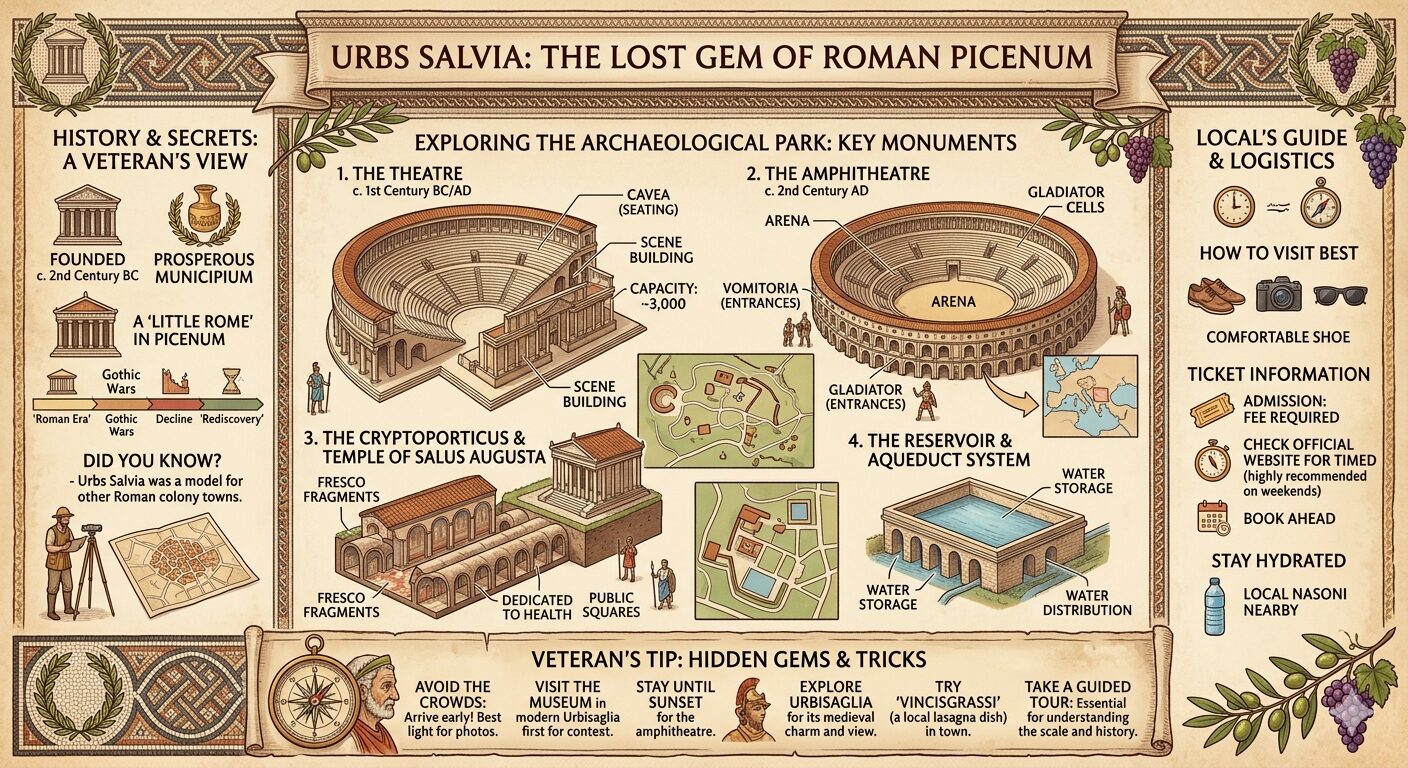
- The Roman Theatre (I Century AD): Built in the early Imperial era, it could hold over 4,000 spectators. The cavea (seating area) is exceptionally well-preserved.
- The Hidden Gem: Beneath the seating tiers, the ambulatories (internal corridors) now house a museum. Do not miss the marble heads and the “Statue of the Sleeping Hermaphrodite.” The acoustics are still so perfect that even a whisper on stage can be heard in the top row.
- The Appian Way (Decumanus Maximus): This isn’t just a road; it’s the 1st-century “highway” of the world. The basalt stones (basoli) are original. If you look closely, you can still see the ruts worn into the stone by centuries of heavy wagon traffic. It literally bisects the city, reminding us that Minturnae was a city built for the road.
- The Forums: The site features two forums. The Republican Forum (II century BC) was the heart of the early colony, while the Imperial Forum was later built to reflect the growing prestige of the city under the Emperors. Here stood the Temple of Jupiter, the religious fulcrum of the community.
- The Aqueduct: Stretching towards the city, the arches of the aqueduct (built in opus reticulatum) are a testament to Roman hydraulic genius. It brought fresh water from the Spigno Saturnia springs, over 11 kilometers away.
Mock Guided Tour: A Walk with the Veteran
“Close your eyes for a second. Hear that? It’s not just the wind in the reeds. It’s the sound of sailors from the Garigliano docks shouting to merchants on the Appia. We are standing on the Decumanus. To your left, the smell of incense from the Capitolium; to your right, the roar of the crowd in the Theatre. As we walk, feel the smoothness of the basalt under your feet—the same stone touched by Horace on his famous journey to Brundisium. Now, look at the theatre’s red bricks against the blue sky; that is the color of power and permanence.”
Daily Life in Minturnae
Life here was a vibrant mix of cultures. As a river port, Minturnae welcomed people from all over the Mediterranean. Sailors, soldiers, and bureaucrats mingled in the macellum (market). People spent their mornings at the Forum for business and their afternoons at the theatre or the public baths, discussing the latest news from Rome, which was only a few days’ journey away.
My dear friend, sit back and let me tell you about the road that taught the world how to move. In my forty years of walking these stones, I’ve realized that the Appian Way isn’t just an archaeological site—it’s the very soul of Italy, a line of basalt that connects the heart of Rome to the echoes of the East.
In 2024, the “Via Appia. Regina Viarum” was finally inscribed as a UNESCO World Heritage Site, a long-overdue recognition for the most famous “highway” in human history.
The Appian Way: Regina Viarum – The Queen of Roads
The Romans didn’t just build roads; they built destiny. In 312 BC, the censor Appius Claudius Caecus decided that Rome needed a direct military link to the south, specifically to Capua. Before the Appia, paths were muddy, winding trails that followed the hills. Appius changed everything by drawing a straight line through marshes and mountains alike.
Eventually, the road was extended to Brindisi, the gateway to Greece and the Orient. It became the lifeblood of the Empire, where soldiers, philosophers, merchants, and even the Apostle Peter once walked.
Why It Matters: Innovation and Prestige
-
Engineering Marvel: It was the first long-distance road built with a scientific approach. The Romans used multi-layered foundations (statumen, rudus, nucleus, and summa crusta) to ensure it would last forever. And as you can see, they weren’t wrong.
-
The “Social Network” of Antiquity: Because Roman law forbade burials inside the city walls, the Appian Way became a prestigious outdoor gallery. The wealthy built massive tombs and monuments here to ensure their names were seen by everyone traveling to the capital.
-
Cultural Hub: It’s where the Mediterranean world met. Silk, spices, and ideas traveled up this road to transform a small city on the Tiber into the center of the world.