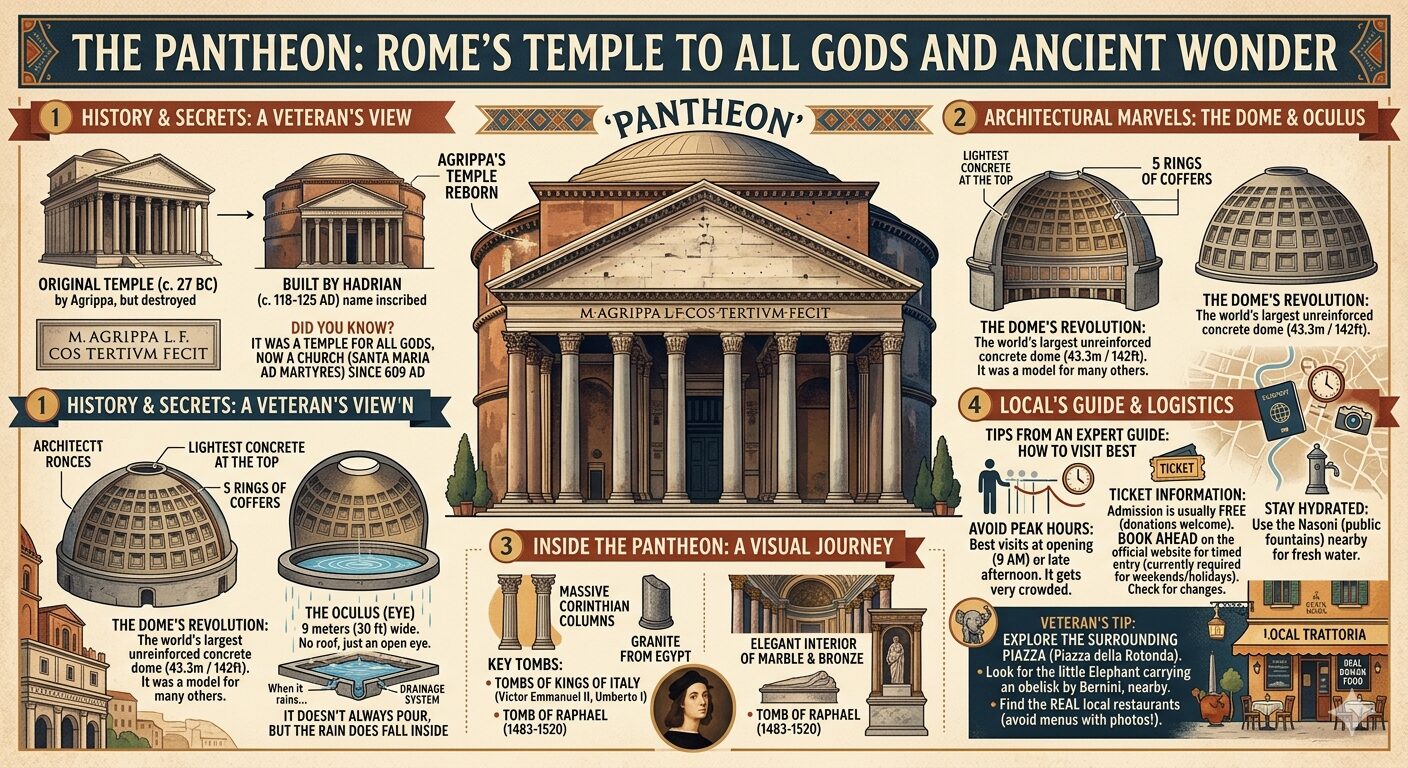
The Pantheon: A Masterpiece of Roman Engineering
The Pantheon is perhaps the best-preserved Roman monument in the world. Located in the heart of Rome, it is celebrated for its sheer grandeur, construction wisdom, and the unique way it combines a thermal-style round cella with a traditional gabled portico.
1. Piazza della Rotonda
The journey begins in the large square, Piazza della Rotonda, which still echoes the layout of the ancient porticoed space that once stood before the temple.
- Historic Facades: The 18th-century building facades surrounding the square partially trace the ancient Roman boundaries.
- The Fountain: At the center stands a fountain in grey African marble, designed by Giacomo della Porta and sculpted by Leonardo Sormani (1575). It features a mixed-line plan adorned with masks and dolphins (restored in 1880).
- The Obelisk of Ramses II: Crowning the fountain is a small Egyptian obelisk from the Iseo Campense. It was moved here from nearby Piazza di San Macuto by Pope Clement XI in 1711.
- Market History: Near house number 14, look for an inscription commemorating the local market that was held in this square until 1847.
2. Etymology and Origins
The word Pantheon is a Greek loanword inherited through Latin: from τό Πάνθειον (ίερόν), meaning “The temple of all the gods.”
- Symmetry and Skies: The Roman senator and historian Cassius Dio hypothesized that the name derived either from the numerous statues of gods lining the walls or from the dome’s resemblance to the celestial vault.
- A Nickname?: Dio’s uncertainty suggests that “Pantheon” might have been a popular nickname rather than the official name of the building. The concept of a single temple dedicated to every deity remains a subject of historical debate.
3. Historical Timeline
The building seen today is the result of centuries of reconstruction and transformation:
- Agrippa’s Temple (27 BC): The original structure was built by Marcus Vipsanius Agrippa, son-in-law of Augustus. Traces of this primitive temple are preserved 2 meters below the current portico level.
- Hadrian’s Reconstruction (118-125 AD): After fires destroyed previous versions during the reigns of Domitian and Trajan, Emperor Hadrian rebuilt it entirely. In a gesture of respect, he re-proposed the original inscription on the front:
M·AGRIPPA·L·F·COS·TERTIVM·FECIT. - Christian Transformation (608 AD): Abandoned for two centuries after the fall of Rome, the monument was ceded by Emperor Phocas to Pope Boniface IV, who dedicated it as Santa Maria ad Martyres (the Madonna and all martyrs).
- The Barberini Era (1625): Urban VIII Barberini famously removed the bronze lining of the portico beams to cast cannons and St. Peter’s baldachin. He also commissioned Bernini to add two bell towers (mockingly called “donkey ears”), which were finally demolished in the 1880s.
4. Exterior Features
The exterior presents an imposing mass that hides a delicate internal balance:
- The Portico (Pronaos): 33 meters wide and 16 meters deep, it is supported by 16 monolithic columns made of grey and pink granite, each standing 13 meters high.
- The Bronze Doors: While majestic, the current doors date back to a restoration during the age of Pius IV, rather than antiquity.
- The Rotunda: The brick walls are a massive 6.2 meters thick, strategically segmented by niches and discharge arches to distribute the immense weight of the vault.
5. The Interior and the Dome
Inside, the architecture creates a perfect harmony of space—a sphere inscribed within a cylinder.
- The Dome: It features a diameter of 43.3 meters, which is exactly equal to the height from the floor to the peak. It was cast using a specialized concrete mix containing lightweight volcanic lapillus.
- Coffer Decoration: The vault is adorned with five orders of 28 coffers. These recessed panels shrink in size as they reach the top, creating an optical illusion of greater height.
- The Oculus: A 9-meter wide opening at the summit is the primary source of light (and rain), symbolizing the connection between the temple and the heavens.
- The Floor: The floor features a magnificent pattern of squares and circles in polychrome marbles; much of it is the original Roman masonry.
6. Notable Tombs and Chapels
The circular perimeter is lined with seven large niches and various chapels housing masterpieces of art and the remains of Italy’s greatest figures:
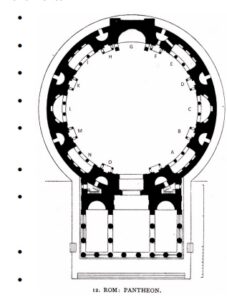
- Raphael’s Tomb: The Renaissance master Raphael (Raffaello Sanzio) is buried under Niche K. Above his tomb is the Madonna del Sasso (1520), a sculpture by Lorenzetto which Raphael himself commissioned.
- Royal Tombs: The Pantheon is the final resting place for the Kings of Italy: Vittorio Emanuele II (Chapel C), Umberto I, and Queen Margherita of Savoia (Chapel L).
- Artistic Masterpieces: * Chapel A: Features an Annunciation fresco attributed to Melozzo da Forlì.
- High Altar (G): Displays a 7th-century Roman-Byzantine icon of the Madonna and Child encased in silver.
- Chapel N: Dedicated to the “Virtuosi of the Pantheon,” it contains works by Vincenzo De Rossi and remains of artists like Taddeo Zuccari.